Why Do Equipment Operators Need Heat Awareness Cards Too?

Equipment operators often work inside air conditioned cabs, and compared to most people on a worksite, they are not usually exposed to the same heat-related risks. However, equipment operators need heat awareness cards, too, for several reasons. While it may seem like equipment operators are immune to heat concerns on the job, there are good reasons to make sure they have the tools they need to track temperature.

In This Article

Six Reasons Why Equipment Operators Need Heat Awareness Cards Too

Heat awareness cards provide up to the moment information about ambient temperatures and, by extension, thermal risks. This information is important for everyone on your worksite, including your equipment operators. Here are six reasons why they should carry heat awareness cards as well.

Equipment operators transition in and out of the cab frequently

Equipment operators have to jump in and out of their cab often, either to reposition their equipment, perform safety and maintenance checks, consult with other onsite workers or refuel. Every time your equipment operators climb out of their cab, they are exposed to the same heat hazards that the rest of your onsite workers contend with. If they have heat awareness cards on them, they will be able to track those heat hazards as they get in and out of their cab.

Moving from a climate-controlled environment to a hot one can shock the system
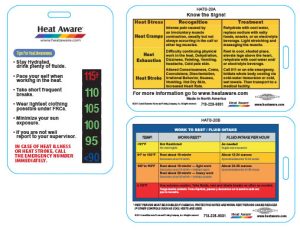
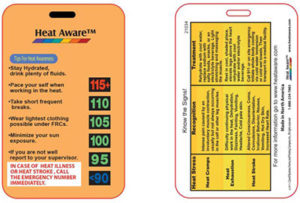
HATS-20 Heat Aware Card with temperature scale and work and rest fluid intake backerWhile equipment operators may be protected by their air conditioned cab, working in a climate-controlled space also affects their ability to tolerate heat. As they move from inside their cab to the outside environment, the sudden increase in temperature can shock their system and increase the risk of dehydration or heat exhaustion. A heat awareness card lets an operator check the temperature every time they step down from the cab, instead of guessing.

This is where the card’s response time matters. According to the Heat Aware product FAQ, the card’s liquid crystal registers the temperature within a degree when it is used and viewed properly, and it reregisters every 20 seconds, which Heat Aware notes is important when moving from one area to another with a significant temperature change. That is the exact situation an operator is in every time the cab door opens.

Elevated heat stress impacts decision making and reaction time

If one of your equipment operators is compromised by heat illness, it will affect their ability to do their job safely. Heat exhaustion reduces reaction speed and decision making, which is particularly risky when in charge of heavy equipment. If one of your equipment operators is affected by heat stress, it is a danger for them and for any nearby workers.

Equipment operators have a wider view of the job site
Heat Aware's Heat Cards - HATS-20A | The signs, symptoms and treatment of heat illnessesEquipment operators typically have an expanded view of the worksite, as they are largely stationary and are situated off the ground. From this position, equipment operators can see if a worker is experiencing heat stress and respond faster than people on the ground.

With a heat awareness card, your equipment operators will know when heat risks are elevated and can begin looking out for their fellow workers. The HATS-20A version of the HATS-20 Heat Aware Card carries the signs, symptoms and treatment of heat illnesses on its backer, so the operator has the warning signs in hand while watching the crew.

Heavy equipment generates additional heat and elevates thermal risks

Heavy equipment creates additional heat that must be accounted for when assessing the risk of heat illness on the jobsite. Engines, hydraulic systems and metal surfaces are hotspots that can make it tougher on any workers nearby. With a heat awareness card, equipment operators can read the temperature near the machine and see whether that additional thermal energy has pushed conditions into a higher risk range. Remember that the card reads air temperature, not humidity, so pair it with a heat index chart when the air is humid.

Cab cooling systems can fail and spike heat risks

Even if your equipment operators spend much of their time in a climate-controlled cab, cooling systems can always fail. Clogged filters and poor ventilation are two reasons why climate control may be taken temporarily offline. No matter the reason, a heat awareness card in the cab tells the operator that conditions have changed, so they can take a break in a cool area, drink water and report the problem before heat stress builds.

How Do Heat Awareness Cards Provide Better Safety on Jobsites?

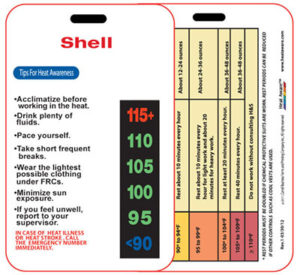
Heat Aware Cards are TWIC-sized, so they fit with the other cards a worker already carries, and the HATSC-30 custom card can be printed with your company’s logo and safety information. They are made with integrated liquid crystal thermometers (LCTs) that provide a rapid, accurate temperature reading. The cards are made of laminated PVC and are waterproof, according to Heat Aware, and because they are light and compact, they can be kept in a breast pocket, worn on a lanyard or kept in the cab where the operator can see them. Compared to other temperature tracking tools, heat awareness cards are inexpensive, simple to use and easy to hand out to an entire crew.

A card works best as part of a plan. Tie the temperature an operator reads to a specific response, such as more frequent breaks or a stop to cool down, and write those responses into your heat illness prevention program so everyone on the site follows the same rules.

Keep Equipment Operators and Their Coworkers Heat Aware

It may seem like the last person onsite who needs heat awareness is an equipment operator, but there are several reasons why that is not the case. Cooling systems can fail, operators have to exit their cab frequently and sudden exposure to intense heat can cause heat risks to spike, even without prolonged exposure.

The best defense against heat illness is information. Heat awareness cards provide this information in a simple, inexpensive format that helps your equipment operators know what to expect regarding heat risks. For more on how the cards are used across a crew, read Can a Heat Safety Card Save a Life?

Browse the HATS-20 Heat Aware Card, the HATS40 card with label and the HATSC-30 custom card, or see everything in the Heat Aware shop. For pricing, availability, volume and custom or branded orders, email Bryan Slaven at bryan@heataware.com.

Give every worker a temperature reading. Heat Aware Cards register the ambient temperature around the person carrying them, with a signs and symptoms or a work and rest backer, and they can be printed with your company’s branding.

See the Heat Aware CardsBrowse the shop

Frequently Asked Questions

Do equipment operators in air conditioned cabs need heat stress training?

Yes. Operators climb out of the cab to refuel, run safety and maintenance checks and talk with the crew, and each time they step into the same heat as everyone else on the site. The sudden change from a cooled cab to outdoor heat is a risk of its own, so operators belong in the same heat awareness training and procedures as the rest of the crew.

Does a Heat Aware Card read body temperature?

No. According to Heat Aware, the card registers ambient temperature, the temperature of the surrounding area, not the body temperature of the person carrying it.

How quickly does the card update when an operator leaves the cab?

Heat Aware states that the card’s liquid crystal registers the temperature within a degree when properly used and viewed, and that it reregisters every 20 seconds. That matters when moving between areas with a large temperature difference, such as a cooled cab and an open jobsite.

What should an operator do if the cab’s air conditioning fails?

Treat the cab as a hot work area until the cooling is fixed. The operator should take breaks in a cool area, drink water, report the failure and watch for early signs of heat illness, following your written heat illness prevention program.

Can heat awareness cards carry our company branding?

Yes. Heat Aware offers the HATSC-30 Custom TWIC-sized card, which can be printed with your corporate logo, colors and information specific to your health, safety and environment group. Contact bryan@heataware.com for custom and branded orders.
How to Run a Heat Stress Toolbox Talk

Heat illness does not announce itself. A worker who is sliding toward heat exhaustion usually looks like a worker having a hard morning, and the people best placed to notice are the ones standing next to him. That is what a toolbox talk is for. Ten minutes before the shift, in the language the crew actually uses, aimed at the one thing you want them to do differently today.

This is a heat stress toolbox talk you can deliver without preparation, plus the questions that come back at you and how to answer them. Awareness is the control that prevents heat illness, and a talk is how awareness gets installed in a crew rather than filed in a binder.

In this article

What to settle before you open your mouth

Read the day first. A toolbox talk that ignores the conditions in front of the crew gets tuned out in the first sentence, and rightly so. Before the talk, know three numbers and one fact.

The three numbers are the forecast high, the humidity, and the heat index the two of them produce together. Humidity is the number crews underestimate. Ninety five degrees in dry air and ninety five degrees at seventy percent relative humidity are not the same shift, because sweat that cannot evaporate does not cool anybody. The one fact is who on the crew is new, back from vacation, back from sick leave, or working in heavier gear than usual. Those are the people most likely to go down, and they are the reason to give the talk at all rather than skip it because the crew has heard it before.

Then pick one behavior. Not five. A talk that asks for five changes gets none of them. Today it might be drinking before the break rather than at it, or it might be that nobody works a hot task alone. Choose it before you start so the talk has somewhere to land.

The ten minute talk, in order

Heat Aware's Heat Cards - HATS-20A | The signs, symptoms and treatment of heat illnessesMinute one, the conditions. Say the heat index out loud and say what it means for today’s work. “It is going to feel like a hundred and four by two o’clock, and we are on the south side of the building all afternoon.” Concrete beats general.

Minutes two to four, the signs. Go through what heat illness looks like from the outside, because that is the version a crew can act on. Heavy sweating that stops. Skin that goes clammy, or goes dry and hot. Cramping. A headache. Nausea. Somebody getting quiet, getting clumsy, repeating himself, or getting short tempered for no reason. Confusion and a stumble are late signs, not early ones, and a worker who has reached them needs help immediately rather than a break. The HATS-20 Heat Aware Card carries this list on the back, which is why handing one out beats reading it from a page.

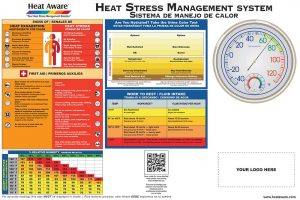
Minutes five to seven, the controls. Water, rest, shade, in that order, and be specific about all three. Where the water is. When the breaks are. Where the shade actually is on this site today, not where it was last week. If you have a heat stress management system sign in the cool down area, point at it and tell them what the thermometer and the humidity reading on it are for.

Minutes eight and nine, the one behavior. Ask for it plainly, explain why it is today’s ask, and say what it looks like done right. Then ask somebody to repeat it back. A talk where nobody speaks is a talk nobody remembers.

Minute ten, the escalation. Who to tell, how, and what happens next. If a worker is confused, stumbling, or cannot be cooled down, that is an emergency call, not a supervisor conversation. Say the words “call nine one one” rather than leaving it implied.

Teaching the buddy check so it survives contact with the job

Heat Aware's Heat Cards - HATS40 | Avoid heat-related illnesses for workersMost heat programs contain a buddy system. Most buddy systems quietly stop happening by the second week of August, because “keep an eye on each other” is not an instruction anybody can follow while running a saw.

Make it mechanical instead. Name the pairs out loud at the talk. Give the check a trigger, so it happens at a moment rather than continuously: at every water break, ask your partner one question and look at him while he answers. Give them the question. “How are you doing” gets “fine” from everybody. “What did you have to drink on the last break” gets an answer you can judge, and so does asking a man to repeat the task sequence back.

New and returning workers get a different pairing

Acclimatization is the control most often missing from a program. A worker who has not been in the heat for a week has lost some of the adaptation he built, and the first days back are the dangerous ones. Pair new and returning people with someone experienced, keep their first days shorter and lighter, and say at the talk that this is deliberate rather than a favor. Working in dangerous heat you are not accustomed to is its own hazard and worth treating as one.

Props beat handouts

A handout gets folded into a pocket and washed. Something a worker carries or wears stays in the work.

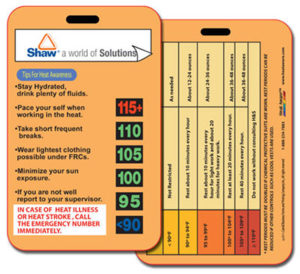
Cards. A Heat Aware Card is TWIC-sized, so it goes in a wallet or behind a badge and comes back out at the next talk. The HATS40 card carries a work and rest reference on the back, which turns “take more breaks” into a specific answer.

Hard hat decals. Hard hat stickers for heat stress awareness put the message where a crew sees it a hundred times a shift without anybody having to say it again. The HADH decal reads Stay Hydrated and the HADS decal reads Drink Early, Drink Often. Heat Aware prints them with UV inks on weatherproof vinyl.

Heat Aware HSMS-01 heat stress management system sign with a thermometer and humidity reading for the cool down areaThe sign in the cool down area. A sign with a thermometer and a hygrometer on it makes the day’s conditions a shared fact instead of an argument. It has to hang in the shade to read accurately, which is worth saying at the talk, because a sign in the sun reads high and teaches the crew to distrust it.

Three talks that did not work, and what was wrong with them

Most heat talks fail in one of a few predictable ways, and each has a specific fix.

The talk that was a policy reading. A supervisor reads the heat section of the safety manual out loud, start to finish, in the same words every week. It covers everything, which is the problem: nothing in it is about today, so there is nothing for a worker to act on. The fix is to cut it to one behavior and attach it to the conditions in front of the crew.

The talk nobody could act on. A crew is told to take breaks as needed and to stay hydrated. Both are true and neither is an instruction. As needed means whatever the busiest man on the crew decides, which in practice means later than it should be. The fix is to name the thing: where the water is, when the breaks are, what counts as a drink, and who decides when the schedule changes.

The talk that was delivered to the wrong people. Everything goes to the crew and nothing goes to the supervisors. But recognizing heat illness in somebody else, and having the authority to stop work, are supervisor jobs. A crew that has been told to speak up and a supervisor who has not been told to listen produces the worst outcome of all, which is a worker who said something and was waved off. Run a version of the talk for the people who make the call, and tell the crew you have done it.

How often to run it, and how to keep it from going stale

Weekly through the hot season is a reasonable floor, daily when the heat index climbs into the range where your program calls for extra breaks, and again whenever the crew changes or the work moves to a hotter part of the site. The talk that matters most is the one on the first genuinely hot day of the year, before anybody has acclimatized.

Staleness is the real risk, and rotating one thing prevents it. One week the talk is the signs. The next it is hydration and what actually counts as a drink. The next it is a walk of the site to find where the shade and water will be. Ask a different person each week to say one thing he saw last week. A talk that only ever comes out of the supervisor’s mouth stops being heard in about a month.

What to write down afterward

Keep the record short enough that it actually gets kept. The date, the conditions, who attended, the one behavior you asked for, and anything a worker raised. Two lines and a signature sheet is plenty.

The reason to keep it is not paperwork. It is that a pattern only becomes visible in writing. Three weeks of notes saying the water station is too far from the work face is a site layout problem, and nobody would have spotted it from three separate conversations. Under the General Duty Clause an employer is responsible for recognized hazards in the workplace, and heat is one; OSHA has no heat-specific standard of its own. A record of what you told the crew, and what you changed when they told you something back, is the honest evidence that the hazard was being managed.

Put heat awareness where the work happens. Heat Aware Cards, heat stress management system signs and hard hat stickers put the temperature and the warning signs in front of the crew, and they work best as part of a written heat illness prevention program.

Browse the Heat Aware shopWhat a heat stress system includes

Frequently asked questions

How long should a heat stress toolbox talk be?

Ten minutes is enough, and shorter is better than longer. A talk that runs past about fifteen minutes stops being absorbed. Cover the day’s conditions, what heat illness looks like from the outside, where water, rest and shade are, one behavior you want changed today, and who to call in an emergency.

What should the crew be able to do after the talk?

Three things. Name two or three outside signs of heat illness in a coworker, say where water and shade are on this site today, and say who they call and how if somebody is confused or cannot be cooled down. If they can do those three, the talk worked.

How often should we hold one during the summer?

Weekly through the hot season as a floor, daily when the heat index reaches the range where your program calls for extra breaks, and again whenever the crew changes or the work moves to a hotter area. The first genuinely hot day of the year is the most important one, because nobody is acclimatized yet.

Do we need a written heat program to run toolbox talks?

No. You can start talking to the crew this week. A written program is what makes the talks consistent between supervisors and between sites, and it is what tells everybody the same thing about break schedules, water, acclimatization and escalation, so the two work together rather than one replacing the other.

For pricing, availability, volume and custom or branded orders, email bryan@heataware.com or call Heat Aware at 713-228-9331.

Can a Heat Safety Card Save a Life?

Heat exhaustion is potentially fatal at the worksite, as it can progress to heat stroke if it is not recognized and treated right away. The goal for safety personnel is to make sure workers are protected from heat dangers, and a heat safety card is a practical tool for keeping that protection in the worker’s hand.

There are several heat safety measures employers can take to reduce the risk of dehydration and, by extension, heat illnesses like heat exhaustion. One of those measures is equipping workers with TWIC-sized heat cards, printed in the same credential size many industrial sites already issue, and capable of tracking ambient temperature.

In This Article

How Do Heat Safety Cards Keep Workers Safe from Heat Stress?

If heat is a potential hazard at your worksite, you are required to protect workers under OSHA’s General Duty Clause. Standard heat safety measures include developing a heat safety and emergency plan, setting up water break stations, monitoring worker health, and adjusting work rotations when conditions are dangerously hot.

In addition to those measures, employers can equip workers directly by supplying them with heat safety cards. Here is what these cards offer:

  • Heat Aware's Heat Cards - HATS40 | Avoid heat-related illnesses for workersLiquid crystal thermometer (LCT) technology – Liquid crystal thermometers provide a rapid, accurate temperature reading. They can be built into a TWIC-sized card, so workers always have a temperature-taking tool on hand. The best defense against dehydration and heat exhaustion is information, and an LCT card gives your field personnel direct insight into heat levels where they are standing.
  • Critical heat safety information – Your heat safety cards can be printed with other reference details, like hydration guidelines, the warning signs of heat illness, or onsite emergency contact information.
  • Additional branding opportunities – Cards can also carry your company’s brand marks, which reinforces your organization’s commitment to safety every time a worker looks at one.
  • A lightweight, usable safety tool – Heat safety cards are extremely light and compact, and they fit an existing badge holder or lanyard. They are also simple to use, so they deliver consistent value to safety initiatives.
  • A cost-effective safety tool – Heat safety cards are inexpensive to produce at volume and can be laminated for added durability. That makes it easy to outfit an entire crew rather than a handful of supervisors.

Heat illness is preventable when it is recognized early and acted on. A card does not do that work by itself. What it does is put the temperature and the warning signs in a worker’s hand at the moment those things matter, which is what makes early recognition and a fast response possible. For a modest investment, many employers find it is worth outfitting their workers with that awareness. Our breakdown of how these cards add value goes deeper on the cost side.

How Do Heat Safety Cards Help Workers Recognize Dehydration and Heat Exhaustion?

Heat Aware's Heat Cards - HATS-20A | The signs, symptoms and treatment of heat illnessesHeat safety cards are meant to be worn on a lanyard or carried in a pocket for easy reference when temperatures climb. They act as a reminder of the signs to look for and what to do when heat illness emerges, and nothing matters more than recognizing what is happening and taking immediate steps. That means knowing the signs of dehydration and heat exhaustion.

Signs of Dehydration

  • Persistent thirst
  • Fatigue
  • Dizziness and loss of coordination
  • Confusion
  • Loss of skin turgor, where skin does not return to its original position after being pulled

Dehydration is a primary risk factor for heat illnesses like heat exhaustion and heat stroke. Conversely, regular hydration is one of the strongest protective measures available. If your personnel are not adequately hydrated, it can lead to heat exhaustion, which presents with the following symptoms.

Signs of Heat Exhaustion

  • Fatigue
  • Dizziness
  • Fainting
  • Nausea and vomiting
  • Headache
  • Elevated body temperature

Dehydration and heat exhaustion present with similar signs, so it is not always clear which one is causing symptoms. Both are treated in similar fashion: move the worker to a cool, shaded area, give them water, and use any available resources to lower body temperature, including cool packs and wet cloths. It is also important to seek medical treatment during or following a bout of heat illness, because it can escalate quickly and cause long term complications or even death. Training your crew to recognize heat stress on the jobsite is what turns a card into a response.

Prioritize Heat Safety with Better Tools and Better Safety Procedures

Heat is invisible, odorless, and can intensify gradually without notice, so it can produce an emergency quickly. That is why it is important for employers to establish a heat safety plan ahead of time. A plan should include:

  • Identifying any potential heat hazards at the worksite
  • Acquiring and inventorying heat safety resources, including heat safety cards, cold packs, and electrolyte tablets
  • Monitoring worksite conditions for changes in temperature
  • Altering work schedules or switching to light duty
  • Recording contact information for a nearby medical facility

Heat Aware's Heat Cards | HATSC-30: The Custom Twic Sized Card | Keep workers safe from a heat-related illnessEmployers who combine these measures give their workers the best available protection against heat risks. If you are responsible for safeguarding worker health onsite, heat safety cards and the procedures around them are a straightforward place to start. Our guidance on building a heat safety plan covers the emergency action plan side in more detail.

Heat Aware Cards are available in standard, labeled, and fully custom versions in our online shop. For pricing, availability, volume orders, or a card branded for your company, contact Bryan Slaven at bryan@heataware.com.

Give every worker a temperature reading. Heat Aware Cards register the ambient temperature around the person carrying them, with a signs and symptoms or a work and rest backer, and they can be printed with your company’s branding.

See the Heat Aware CardsBrowse the shop

Frequently Asked Questions

What is a heat safety card?

A heat safety card is a durable reference card printed in the same TWIC credential size that many industrial sites already issue, so it fits an existing badge holder or lanyard. It carries heat safety information such as warning signs and hydration guidance, and some versions include an integrated liquid crystal thermometer for reading ambient temperature. It is not a TWIC credential and does not serve any identification or access purpose.

What is a liquid crystal thermometer?

A liquid crystal thermometer, or LCT, is a simple temperature-taking tool that provides a rapid, accurate reading. LCTs use thermochromic liquid crystals that change color as temperature changes, and they can be encapsulated and scaled down to fit inside a TWIC-sized card, which gives workers temperature monitoring wherever they are working.

Who can benefit from carrying a heat safety card?

Anyone who works where heat hazards are present. Construction and maintenance crews are the most common examples, and workers in manufacturing, refineries, bakeries, industrial settings, and commercial kitchens face the same exposure. Athletic programs use them as well, since heat illness risk on a practice field follows the same pattern as it does on a jobsite.

Can a heat safety card be branded for our company?

Yes. Cards can be printed with your company’s brand marks along with the reference information your crews need, such as onsite emergency contacts or your own heat response thresholds. Contact Bryan Slaven at bryan@heataware.com to discuss a custom or branded card for your operation.