
Heat is the number one weather related killer in the United States, and the crews most exposed to it are rarely the ones in a position to stop and assess their own condition. A heat stress management system exists to close that gap. It is not one product. It is a set of awareness tools placed where the work happens, sitting on top of a written program that decides what people actually do when the heat index climbs.
This page sets out what a heat stress management system includes, what belongs to the employer rather than the equipment, and what to have in place before the season starts.
In this article
What a heat stress management system is
Heat illness does not arrive suddenly. It builds through a shift, and the early stages look like an ordinary hard day: a bit slower, a bit irritable, a headache that gets blamed on the sun. By the time somebody feels bad enough to speak up, the body has usually been struggling for a while. That is why recognition, not endurance, is the thing worth engineering for.
A heat stress management system is the set of tools that keeps recognition available at the moment it is needed. A sign at the water station that shows the ambient temperature and humidity together. A card in a worker’s pocket that lists the signs and symptoms. A decal on the hard hat that says drink early. Cooling worn on the body when the work cannot be moved out of the heat.
How much risk a crew is carrying is not the same from site to site. A refinery unit, a bakery floor, a roof in August and an unventilated equipment room are different work environments, and the same air temperature means something different in each. Radiant heat, humidity, air movement and the workload itself all change what the body is dealing with, so a system has to be sized to the environment rather than bought as a standard kit.
None of those items prevents heat illness on its own, and it is worth being plain about that. Prevention comes from the program: water, rest, shade, acclimatization, supervisors who know what they are looking at, and a plan for the moment somebody goes down. The system is what keeps that program present on the job instead of filed in a binder nobody opens in August.
The reason to treat it as a system rather than a shopping list is consistency. When the sign, the card and the decal all carry the same message and the same visual language, a crew reads them as one program. When they are bought separately over three years from three suppliers, they read as clutter.
The four places awareness has to live
Fixed locations: signs at the water station
 Somewhere on every site there is a place people already go to cool down and drink. That is where the reference information belongs, because it is the one spot a worker is already standing still.
The HSMS-01 heat stress management system sign carries a thermometer showing ambient temperature alongside relative humidity, so the heat index danger zones can be read off the wall rather than guessed at. Both signs, where to hang each one and the replacement parts are covered on the heat stress signs and posters page. It suits cool-down areas inside or out. The HSMS-02 sign with the magnetic heat index has the same features and adds four colored and labeled magnets, which lets a supervisor set the current condition where everybody can see it and change it as the day moves.
The value of a fixed sign is that it is the same every day, in the same place, for everybody. It does not depend on anyone remembering to hand something out.
On the person: Heat Aware Cards
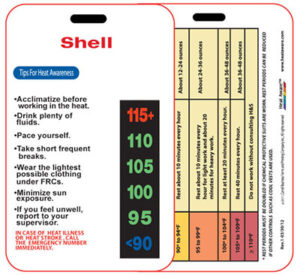 A sign works while somebody is standing at it. A card works everywhere else.
Heat Aware Cards are sized to sit with a TWIC card or hang on a lanyard, so they travel with the worker rather than staying at the gate. The card back is where the useful detail sits: one version carries the signs, symptoms and treatment of the heat illnesses a crew is likely to meet, and another carries a work and rest fluid intake schedule. Both put the information in the hand of the person who needs it rather than in the hands of the person who ordered it.
Cards can also be produced to a company’s own standards, with input from the industrial hygienist or EHS manager who owns the program, and the liquid crystal temperature scale can be customized. For a longer look at why this format works, we wrote about what a heat safety card actually does on a jobsite. A Heat Aware lanyard with a breakaway safety feature is the usual way to keep the card visible rather than buried in a pocket.
On the gear: hard hat decals
 The cheapest piece of awareness on a site is a sticker, because it needs no power, no signal and no login, and every worker who looks at a colleague sees it too.
The three Heat Aware hard hat stickers carry the short version of the message: stay hydrated, drink early and drink often, and the Heat Aware oval that ties a full program together. They are the part of the system people see a hundred times a shift without thinking about it, which is exactly the point.
On the body: cooling worn through the shift
Some work cannot be moved out of the heat, and some of it cannot be paused for long. Where that is true, cooling worn on the body is the remaining control. Heat Aware carries cooling neck wraps and cooling skull caps for crews in that position. These are a complement to water, rest and shade rather than a substitute for them, and they do not change how often a crew needs to come out of the heat.
What the employer puts around it
Equipment is the visible half. The half that decides whether anybody goes home safe is written, and it belongs to the employer.
Water, rest and shade, with the schedule decided in advance
Thirst is a late signal. A worker who waits until they are thirsty is already behind, and catching up during a shift in high heat is difficult. That makes drinking a scheduled activity rather than a personal decision, which in turn means somebody has to decide the schedule, provide the water within reach of the work, and make sure a rest break in shade is a normal thing to take rather than something that has to be justified.
How often breaks should be taken is a question with no single answer, which is why the schedule belongs in the written program rather than a supervisor’s judgment on the day. What it gets built from is consistent: the heat index rather than air temperature alone, the workload, what the crew is wearing, and how acclimatized they are. As any of those rises so does the risk, and the rest portion of each hour rises with it. OSHA and NIOSH both publish heat guidance safety teams use to set those bands.
Recovery is the part that gets skipped. A rest break only works if the body actually cools during it: shade or a conditioned space, hydration within reach, and long enough to matter. Monitoring closes the loop, with somebody watching conditions, checking the schedule is followed, and adjusting when the day changes.
Acclimatization for new and returning workers
The people most likely to be injured by heat are the ones least used to it: new hires, workers back from vacation or illness, and anyone who has just moved from an air conditioned role to an outdoor one. Their bodies have not adjusted, and a first full shift in extreme heat is where a lot of incidents happen. A graduated schedule over the first week is the control, and it needs to be written down or it does not happen. We covered this in more detail in our piece on working in heat you are not used to.
Supervisors who know what they are looking at
A supervisor who can tell heat exhaustion from heat stroke, and who knows that confusion or a stumble is an emergency rather than a reason to send somebody to sit in a truck alone, is worth more than any single item on this page. Training is what turns the signs printed on a card into a decision somebody makes in the field, and the practical form it takes is a short briefing before the shift rather than a course once a year. Our ten minute heat stress toolbox talk sets out what to cover, in what order, and the questions that come back from a crew.
A response plan somebody has actually read
The plan needs to name who calls for help, where the nearest shaded and cooled space is, how the location gets described to an ambulance crew, and what the people standing there do in the minutes before it arrives. Heat stroke moves fast, and the gap between a plan on paper and a plan people have rehearsed is measured in exactly those minutes.
Where OSHA fits, and where it does not
There is no federal OSHA standard dedicated to heat in effect. OSHA published a proposed heat injury and illness prevention rule for outdoor and indoor work settings in August 2024, and according to OSHA’s own rulemaking page that rule is still at the proposal stage and has not been finalized. Several states run their own heat rules, so the answer for any particular site depends on where it is.
What applies everywhere in the meantime is the General Duty Clause, which obliges an employer to keep the workplace free from recognized hazards likely to cause death or serious physical harm. Heat is a recognized hazard. OSHA also publishes heat guidance and campaign material that safety teams use to shape a program.
What that means in practice is that the obligation sits with the employer and the program, not with any product. No sign, card, decal or wrap makes a site compliant with anything, and nothing on this site should be read as saying otherwise. Our guide to OSHA and heat stress in the workplace goes through how safety teams use the published material when building a program.
Source: OSHA heat injury and illness prevention rulemaking page, checked September 2026.
Putting a system in before the season
The worst time to specify a heat stress program is the week it becomes urgent. Signs have to be mounted, cards have to be produced and distributed, and acclimatization schedules only work if they start before the first extreme day rather than after it.
A workable order of operations looks like this. Decide who owns the program and write the plan first, because everything else is sized by it. Walk the site and pick the cool-down locations, then put a sign at each one. Work out the headcount and get a card to every person who works in the heat, including contractors and anyone who visits the hot areas regularly. Add decals to the hard hats at the same time, because doing it in one pass is the only way they all get done. Brief the supervisors before the crews. Then run the acclimatization schedule from the start of the season rather than from the first incident.
Everything described here is available through the Heat Aware shop. For volume quantities, custom artwork, branded cards or a complete system quoted for a specific site, contact Bryan Slaven at bryan@heataware.com. He handles pricing and availability directly. The office can also be reached at 713-228-9331.
Related reading
- The benefits of a heat management system, on what changes on the ground once one is in place.
- Why heat awareness is essential for safety managers, on where to start if you own the program.
- Heat awareness in manufacturing facilities, for indoor heat from ovens, furnaces and poor airflow.
- Preventing heat illness in workers wearing heavy PPE, where the clothing itself is the added load.
- Preparing your crew for the summer heat, a seasonal checklist.
- Eight heat illness prevention tips, the short practical list.
- Accuracy and heat cards, on why the measurement on the card matters.
- Heat Aware product FAQ, for questions about the products themselves.
Frequently asked questions
What does a heat stress management system include?
Four things in four places: a sign at each cool-down location showing temperature and humidity, a card carried by every worker with the signs, symptoms and a work and rest schedule, a decal on the hard hat carrying the short reminder, and cooling worn on the body where the work cannot be moved out of the heat. Underneath all of it sits the employer’s written program covering water, rest, shade, acclimatization, supervisor training and a response plan.
Does a heat stress management system make a site OSHA compliant?
No. There is no federal OSHA standard dedicated to heat in effect, and no product makes a site compliant with anything. The obligation sits with the employer under the General Duty Clause, which covers recognized hazards including heat, and with any state rule that applies. Awareness tools support a program; they do not replace one or satisfy a legal requirement.
Where should the signs go?
At the places people already stop to drink and cool down, inside or out. A sign works while somebody is standing at it, so it belongs where they are already standing still. If a site has several cool-down areas, each one needs its own sign rather than one central sign people are expected to walk to.
Who needs a heat card?
Everyone who works in the heat, which usually includes more people than the headcount suggests. Contractors, drivers, inspectors and anyone who spends part of the day in a hot area are all exposed, and they are often the people furthest from the written program. Cards travel with the person, so they are the practical way to reach that group.
When should a system be put in place?
Before the season, not during it. Signs have to be mounted, cards produced and distributed, and supervisors briefed, and acclimatization only works if the graduated schedule starts before the first extreme day. A program specified in the week it becomes urgent arrives after the exposure it was meant to manage.
Can the cards and signs be branded to our company?
Yes. Cards can be produced to a company’s own standards with input from the EHS manager or industrial hygienist who owns the program, and the temperature scale can be customized. Contact Bryan Slaven at bryan@heataware.com for custom artwork, branded orders, volume quantities and availability.