
How to Run a Heat Stress Toolbox Talk

Heat illness does not announce itself. A worker who is sliding toward heat exhaustion usually looks like a worker having a hard morning, and the people best placed to notice are the ones standing next to him. That is what a toolbox talk is for. Ten minutes before the shift, in the language the crew actually uses, aimed at the one thing you want them to do differently today.

This is a heat stress toolbox talk you can deliver without preparation, plus the questions that come back at you and how to answer them. Awareness is the control that prevents heat illness, and a talk is how awareness gets installed in a crew rather than filed in a binder.

In this article

What to settle before you open your mouth

Read the day first. A toolbox talk that ignores the conditions in front of the crew gets tuned out in the first sentence, and rightly so. Before the talk, know three numbers and one fact.

The three numbers are the forecast high, the humidity, and the heat index the two of them produce together. Humidity is the number crews underestimate. Ninety five degrees in dry air and ninety five degrees at seventy percent relative humidity are not the same shift, because sweat that cannot evaporate does not cool anybody. The one fact is who on the crew is new, back from vacation, back from sick leave, or working in heavier gear than usual. Those are the people most likely to go down, and they are the reason to give the talk at all rather than skip it because the crew has heard it before.

Then pick one behavior. Not five. A talk that asks for five changes gets none of them. Today it might be drinking before the break rather than at it, or it might be that nobody works a hot task alone. Choose it before you start so the talk has somewhere to land.

The ten minute talk, in order
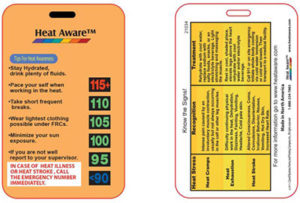
Heat Aware's Heat Cards - HATS-20A | The signs, symptoms and treatment of heat illnessesMinute one, the conditions. Say the heat index out loud and say what it means for today’s work. “It is going to feel like a hundred and four by two o’clock, and we are on the south side of the building all afternoon.” Concrete beats general.

Minutes two to four, the signs. Go through what heat illness looks like from the outside, because that is the version a crew can act on. Heavy sweating that stops. Skin that goes clammy, or goes dry and hot. Cramping. A headache. Nausea. Somebody getting quiet, getting clumsy, repeating himself, or getting short tempered for no reason. Confusion and a stumble are late signs, not early ones, and a worker who has reached them needs help immediately rather than a break. The HATS-20 Heat Aware Card carries this list on the back, which is why handing one out beats reading it from a page.

Minutes five to seven, the controls. Water, rest, shade, in that order, and be specific about all three. Where the water is. When the breaks are. Where the shade actually is on this site today, not where it was last week. If you have a heat stress management system sign in the cool down area, point at it and tell them what the thermometer and the humidity reading on it are for.

Minutes eight and nine, the one behavior. Ask for it plainly, explain why it is today’s ask, and say what it looks like done right. Then ask somebody to repeat it back. A talk where nobody speaks is a talk nobody remembers.

Minute ten, the escalation. Who to tell, how, and what happens next. If a worker is confused, stumbling, or cannot be cooled down, that is an emergency call, not a supervisor conversation. Say the words “call nine one one” rather than leaving it implied.

Teaching the buddy check so it survives contact with the job
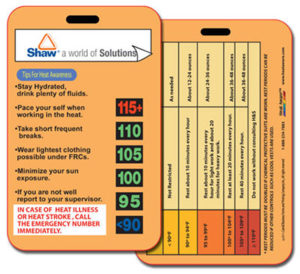
Heat Aware's Heat Cards - HATS40 | Avoid heat-related illnesses for workersMost heat programs contain a buddy system. Most buddy systems quietly stop happening by the second week of August, because “keep an eye on each other” is not an instruction anybody can follow while running a saw.

Make it mechanical instead. Name the pairs out loud at the talk. Give the check a trigger, so it happens at a moment rather than continuously: at every water break, ask your partner one question and look at him while he answers. Give them the question. “How are you doing” gets “fine” from everybody. “What did you have to drink on the last break” gets an answer you can judge, and so does asking a man to repeat the task sequence back.

New and returning workers get a different pairing

Acclimatization is the control most often missing from a program. A worker who has not been in the heat for a week has lost some of the adaptation he built, and the first days back are the dangerous ones. Pair new and returning people with someone experienced, keep their first days shorter and lighter, and say at the talk that this is deliberate rather than a favor. Working in dangerous heat you are not accustomed to is its own hazard and worth treating as one.

Props beat handouts

A handout gets folded into a pocket and washed. Something a worker carries or wears stays in the work.

Cards. A Heat Aware Card is TWIC-sized, so it goes in a wallet or behind a badge and comes back out at the next talk. The HATS40 card carries a work and rest reference on the back, which turns “take more breaks” into a specific answer.

Hard hat decals. Hard hat stickers for heat stress awareness put the message where a crew sees it a hundred times a shift without anybody having to say it again. The HADH decal reads Stay Hydrated and the HADS decal reads Drink Early, Drink Often. Heat Aware prints them with UV inks on weatherproof vinyl.
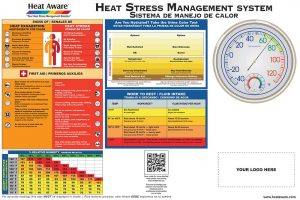
Heat Aware HSMS-01 heat stress management system sign with a thermometer and humidity reading for the cool down areaThe sign in the cool down area. A sign with a thermometer and a hygrometer on it makes the day’s conditions a shared fact instead of an argument. It has to hang in the shade to read accurately, which is worth saying at the talk, because a sign in the sun reads high and teaches the crew to distrust it.

Three talks that did not work, and what was wrong with them

Most heat talks fail in one of a few predictable ways, and each has a specific fix.

The talk that was a policy reading. A supervisor reads the heat section of the safety manual out loud, start to finish, in the same words every week. It covers everything, which is the problem: nothing in it is about today, so there is nothing for a worker to act on. The fix is to cut it to one behavior and attach it to the conditions in front of the crew.

The talk nobody could act on. A crew is told to take breaks as needed and to stay hydrated. Both are true and neither is an instruction. As needed means whatever the busiest man on the crew decides, which in practice means later than it should be. The fix is to name the thing: where the water is, when the breaks are, what counts as a drink, and who decides when the schedule changes.

The talk that was delivered to the wrong people. Everything goes to the crew and nothing goes to the supervisors. But recognizing heat illness in somebody else, and having the authority to stop work, are supervisor jobs. A crew that has been told to speak up and a supervisor who has not been told to listen produces the worst outcome of all, which is a worker who said something and was waved off. Run a version of the talk for the people who make the call, and tell the crew you have done it.

How often to run it, and how to keep it from going stale

Weekly through the hot season is a reasonable floor, daily when the heat index climbs into the range where your program calls for extra breaks, and again whenever the crew changes or the work moves to a hotter part of the site. The talk that matters most is the one on the first genuinely hot day of the year, before anybody has acclimatized.

Staleness is the real risk, and rotating one thing prevents it. One week the talk is the signs. The next it is hydration and what actually counts as a drink. The next it is a walk of the site to find where the shade and water will be. Ask a different person each week to say one thing he saw last week. A talk that only ever comes out of the supervisor’s mouth stops being heard in about a month.

What to write down afterward

Keep the record short enough that it actually gets kept. The date, the conditions, who attended, the one behavior you asked for, and anything a worker raised. Two lines and a signature sheet is plenty.

The reason to keep it is not paperwork. It is that a pattern only becomes visible in writing. Three weeks of notes saying the water station is too far from the work face is a site layout problem, and nobody would have spotted it from three separate conversations. Under the General Duty Clause an employer is responsible for recognized hazards in the workplace, and heat is one; OSHA has no heat-specific standard of its own. A record of what you told the crew, and what you changed when they told you something back, is the honest evidence that the hazard was being managed.

Frequently asked questions

How long should a heat stress toolbox talk be?

Ten minutes is enough, and shorter is better than longer. A talk that runs past about fifteen minutes stops being absorbed. Cover the day’s conditions, what heat illness looks like from the outside, where water, rest and shade are, one behavior you want changed today, and who to call in an emergency.

What should the crew be able to do after the talk?

Three things. Name two or three outside signs of heat illness in a coworker, say where water and shade are on this site today, and say who they call and how if somebody is confused or cannot be cooled down. If they can do those three, the talk worked.

How often should we hold one during the summer?

Weekly through the hot season as a floor, daily when the heat index reaches the range where your program calls for extra breaks, and again whenever the crew changes or the work moves to a hotter area. The first genuinely hot day of the year is the most important one, because nobody is acclimatized yet.

Do we need a written heat program to run toolbox talks?

No. You can start talking to the crew this week. A written program is what makes the talks consistent between supervisors and between sites, and it is what tells everybody the same thing about break schedules, water, acclimatization and escalation, so the two work together rather than one replacing the other.

For pricing, availability, volume and custom or branded orders, email bryan@heataware.com or call Heat Aware at 713-228-9331.

A Complete Guide to OSHA and Heat Stress in the Workplace

Heat stress is a constant threat to workers in many industries, to the extent that OSHA has regulations in place to ensure heat safety in the workplace. Specifically, OSHA’s General Duty clause requires employers to ensure their employees are safe from all identifiable hazards at the work site.

Prioritizing heat safety is also the right thing to do, as heat illness can result in long-term, even fatal effects on workers. Many researchers assert that official data doesn’t capture how many workers die every year due to heat stress on the job, but some data available confirms that dozens of workers suffer fatal heat illnesses every year.

This guide is for employers looking to improve workplace safety and ensure they are in compliance with OSHA regulations.

Risk Factors for Heat Stress

Heat stress leads to heat illness, so minimizing its impact on workers is paramount. That starts with identifying heat stress risk factors, which include:

  • Heat hazards – The most obvious risk factor is the presence of heat-generating sources, like ovens, furnaces and areas where industrial machinery is outputting a lot of thermal energy into the environment (assembly lines are one example).
    Outdoor work typically means one difficult-to-avoid heat hazard: the sun. Duration of sun exposure is an essential data point to track in this case.
  • Work intensity – In workplaces where moderate to intense activity is required, exertion will increase the risk of heat illness. Extended periods of work in hazardous conditions will also increase the chances of experiencing heat illness.
  • Protective wear – Personal protective equipment (PPE) protects against environmental hazards but doesn’t ventilate well and will therefore trap a lot of heat.
  • Certain health conditions and medications – People with certain health conditions, like cardiovascular problems, are at a higher risk of developing heat illness and more likely to experience severe symptoms.

Symptoms of Heat Related Illness

Heat illness may emerge gradually or suddenly. In most cases, there is a brief period of time during which symptoms are present and others have time to respond and help. Recognizing the symptoms of heat illness is critical for a proper emergency response then. Here’s what to look for:

  • Confusion or irritability
  • Loss of balance (ataxia) or weakness
  • Excessive sweating or a complete lack of it
  • Skin that’s clammy or pale
  • Muscle cramps
  • Nausea and vomiting
  • A weak pulse
  • Loss of consciousness

If any of the above signs are present, the worker should be removed from hazardous conditions and have treatment promptly administered.

OSHA Regulations on Heat Stress

OSHA doesn’t have any heat-specific safety regulations on the books, but the General Duty clause also applies to heat hazards. OSHA recommends employers adopt the heat safety standards published by The National Institute for Occupational Safety and Health (NIOSH).

There are several state-level and heat safety regulations, too – published in California, Colorado, Minnesota, Oregon and Washington.

There is momentum toward OSHA publishing heat-specific regulations. In fact, one was proposed in July 2024 – a rule that would require employers to enact specific safety provisions (additional breaks, additional health monitoring, etc.) when certain temperature thresholds are reached. It’s likely that OSHA will eventually publish safety regulations for heat hazards specifically, given the increased scrutiny in this area.

Heat Illness Prevention Strategies in the Workplace

There are many measures employers can implement to improve heat safety, including:

  • Better hydration and nutrition guidelines – Fluid and electrolytes are lost to excessive sweating, which leads to heat illness symptoms. Replacing both is essential to warding off heat exhaustion and heat stroke, and this starts with better hydration and nutrition. Specifically, choosing hydration and electrolyte-replacing foods and drinks, like fluid-rich fruits and sports drinks. Employers are responsible for providing workers with adequate water and breaks to replenish fluids. As the temperature climbs, workers will need water breaks more frequently and will need more water to prevent heat illness.
  • Monitoring workers’ health – Elevated temperatures will place additional stress on workers, and this can mean danger for workers with pre-existing health conditions.
    When conditions are hazardous, onsite safety personnel must be ready to step in and check worker vitals periodically to ensure any signs of heat illness are spotted immediately. High-risk workers with significant health conditions should be monitored closely and rotated to lighter duty, if possible.
  • Preparing an emergency response – OSHA recommends employers develop heat-specifical emergency action plans (EAPs) to ensure a rapid response if heat illness does emerge.
    An EAP should outline the treatment procedures responding personnel will take if a worker experiences heat illness. EAPs outline treatment and provide an inventory of emergency response resources (and their location) and contact information for a nearby hospital or emergency room. EAPs give workers the information they need to respond quickly and effectively.
  • Providing training and educational resources to employees – Once your organization has its heat safety standards in place, they must be reinforced through repeated training drills and safety-focused talk. Ultimately, all forms of workplace safety – including heat safety – are reinforced by top management, so the company’s leaders must take charge in practicing and emphasizing safety. Regular training sessions are an important way to do this.

The Right Resources and Tools Will Also Improve Workplace Heat Safety

The right heat safety resources can make the difference when a heat illness emergency occurs. These resources should be stored in a clearly marked area that all personnel are aware of. Emergency heat illness resources typically include electrolyte tablets, cool packs and wraps. Together, these can bring down dangerous body temperatures quickly and treat dehydration.

Even better, outfit workers with tools that they can use to monitor work conditions and protect themselves when working. One example is liquid crystal thermometers (LCTs) integrated into employee TWIC cards. LCTs provide an accurate temperature reading within seconds and weigh next to nothing, so they can be easily carried and stored. And for organizations on a tight budget, LCTs are low-cost solutions that encourage workers to take charge of workplace safety – something every organization will benefit from.

OSHA and Heat Stress FAQ

What is the status of OSHA’s proposed heat rule?

OSHA announced its proposed Heat Injury and Illness Prevention in Outdoor and Indoor Work Settings rule in July 2024 and published it in the Federal Register on August 30, 2024. Public comments, an informal hearing and a post-hearing comment period followed and closed in 2025. As of October 2026 there is no final rule and no announced date for one. Until a final rule takes effect, OSHA addresses heat hazards through the General Duty Clause and any state rules that apply.

Does OSHA require a written heat illness prevention plan?

There is no federal heat standard in effect today, so OSHA does not have a rule that specifically requires a written heat plan. The proposed rule would require one, and some states with their own heat rules, such as California, already do. Even without a requirement, a written plan is the clearest way to show what your company does about heat and who is responsible for each step. Our guide to a heat illness prevention program walks through what to put in it.

What does OSHA expect employers to provide during hot weather?

OSHA’s long-running guidance comes down to water, rest and shade. Give workers cool drinking water close to the work, rest breaks that get longer and more frequent as the heat index climbs, and a shaded or cooled place to take them. Add a schedule that lets new and returning workers acclimatize, training so supervisors and crews can recognize heat illness, and an emergency plan for when someone gets sick.

How should new workers be acclimatized to the heat?

OSHA and NIOSH guidance for new workers is to start at no more than 20 percent of a normal workload or heat exposure on the first day and increase by no more than 20 percent each day after that. Workers returning after a week or more away need a ramp-up too. Many severe and fatal heat illnesses occur in workers who are new to the job, which is why acclimatization belongs in writing and not left to individual judgment.

Do heat stress cards and signs satisfy OSHA’s heat requirements?

No. No product satisfies an OSHA requirement or makes a workplace compliant. Tools like Heat Aware Cards and heat stress signs and posters support your program by keeping current conditions and the plan’s steps in front of the crew. The obligation itself is met by the employer’s plan, training, supervision and follow-through.

What should a heat emergency action plan include?

It should say who checks on workers during high heat, how to recognize heat exhaustion and heat stroke, and what to do in the first minutes: call 911, move the worker to a cooler area and start cooling right away. List where the cooling supplies are kept, the site address to give emergency responders, and who notifies a supervisor. Practice it before summer so the crew does not learn it during an emergency.

What Are The OSHA Requirements for Heat Safety

The Occupational Safety and Health Administration, or OSHA, is the governing body overseeing the implementation of workplace safety measures. It organizes these measures through various regulations, all of which employers need to be concerned with. As of yet, OSHA does not have particular regulations in place for heat safety, but that doesn’t mean employers can slide on protective measures. OSHA’s General Duty Clause requires employers to be aware of and remove recognizable hazards that are likely to cause serious harm or death to their workers. OSHA considers excessive heat, both environmental and labor-induced, to be among those recognizable hazards. As such, it is the employer’s responsibility to account for the heat and take the appropriate steps to neutralize its effects on employees.

OSHA Requirements For Heat SafetyWhat OSHA Recommends

OSHA may not have a regulation dedicated to heat safety, but it has published materials detailing how to best approach it. These materials should be of interest to any employer that wants to manage heat hazards the way OSHA expects, and they sit alongside what a heat stress management system includes on the job itself. OSHA recommends greater levels of awareness and intervention as the heat index climbs. The heat index takes into consideration both air temperature and relative humidity. As humidity rises, the body’s ability to wick off heat using sweat worsens, so it’s more difficult for workers to mitigate heat caused by labor. As air temperature and humidity rise, it is up to the employer to offset the increased danger with additional resources.

Some of the most important points of heat safety, from OSHA’s perspective, include:

  1. Provide workers with a shaded rest area – Once the heat index climbs above 90 degrees, heat illness becomes a real possibility. Lower heat indexes can also be a concern if the worker is outfitted with impermeable protective gear, including gear designed to protect against chemical or biological agents. As soon as the heat index passes the 90-degree threshold, or when workers are expected to don heavy, insulated gear, OSHA strongly recommends employers provide their employees with shaded rest areas. This area should be shaded at all times, so it should be comprehensive enough to keep the sun from intruding at any point of the day. It’s also best to set the rest area up where it will be unexposed to warm breezes, which can accelerate the onset of heat-related illnesses. A shaded tent is an example of an appropriate rest area. Its mobile design and contained environment is ideal for establishing a cool area, regardless of the location. Tents equipped with air conditioners or heavy-duty fans can offer the ideal base for workers in need of cooling.
  2. Provide workers with plenty of potable water – OSHA recommends water that is between 50 and 60 degrees, and between four and six cups of it every hour. Water consumption should begin before the worker notices thirst, as it may be too late to prevent dehydration once the worker becomes thirsty. There should always be drinking water available, so employers must have procedures in place to ensure supplies are replenished with regularity. Workers, and particularly workers who are new to working in the heat, should be encouraged regularly, and firmly, to drink plenty of water. Most incidences of occupational heat-related illnesses occur among inexperienced workers, as they may not be accustomed to working in the heat.
  3. Monitor workers continuously for signs of heat illness – When the heat index climbs above 90 degrees, supervisors should ensure that all heat safety measures are being observed. Shaded rest areas should be utilized, plenty of water should be consumed and other cooling methods taken advantage of. As the heat index climbs even higher, it is imperative that worksites have experts on heat-related illnesses available. These experts should be able to recognize the signs of heat illness right away and know how to administer first aid to workers experiencing symptoms. The expert should also recommend changes to work schedules in response to dangerous conditions. In short, there should be someone at the worksite who will ensure workers are safe and following protocols related to heat. At higher heat indexes, medical facilities should be available within minutes. If they aren’t, then it is the employer’s responsibility to have resources on hand to treat any heat illness that emerges. If the heat index climbs above 115 degrees, or if workers are fitted with heavy, insulated gear for long stretches of time, then additional, significant measures to prevent heat illness must be deployed. This includes physiologically monitoring workers, regularly checking their heart rate, temperature and other vitals that may indicate overheating. Workers should be acclimatized to an extreme environment like this prior to taking on a full workload.
  4. Provide cooling measures, for both preventative and curative situations – When the heat index passes 103 degrees, it’s important that employers consider personal cooling methods. This will protect workers who must remain in the sun for extended periods of time, and workers who cannot access rest areas as often. Personal cooling may be as simple as clothing that has been dampened with water, or something a bit more advanced, like misting stations. Reflective clothing and vests with cooling packs are also effective. If heat illness does appear, then immediate steps must be taken to prevent permanent injury (or death) to the worker. This includes rapid application of wet cloths, transport to a cooled room, administering fluids and immersion in an ice water bath. As this scenario may cause unconsciousness, it is critical that measures are in place to handle an unconscious person.
  5. Pair workers together while they are exposed to heat – The signs of heat illness can creep in slowly and may not be noticed before they become serious. Using a “buddy system” can help worksite managers detect heat illness faster, which may make the difference in keeping workers safe.

Heat-related illnesses are potentially deadly, and it is up to employers to neutralize hazards before they materialize. Adhering to OSHA recommendations will go a long way in doing this as they provide an excellent starting point.

OSHA Heat Safety FAQ

Does OSHA have a heat stress standard?

Not yet. As of September 2026 there is no final federal heat standard. OSHA published a proposed Heat Injury and Illness Prevention rule on August 30, 2024, and held public hearings from June 16 to July 2, 2025, but a final rule has not been issued. Until one is, OSHA enforces heat hazards through the General Duty Clause and its heat National Emphasis Program.

How does OSHA enforce heat hazards without a heat rule?

Through the General Duty Clause, which requires employers to protect workers from recognized hazards likely to cause death or serious harm. Excessive heat is one of them. OSHA also renewed its National Emphasis Program on heat hazards on April 10, 2026, extending it through 2031. The program covers indoor and outdoor work, targets high-hazard industries, and sets heat priority days when the heat index is 80 degrees or higher, when inspectors can conduct heat inspections and ask about heat safety during other inspections.

What does OSHA look for during a heat inspection?

Inspectors want to see that the employer recognized the heat hazard and did something about it. That usually means a written heat illness prevention plan, drinking water, rest breaks, shade or cool-down areas, an acclimatization schedule for new and returning workers, training for supervisors and crews, and a plan for responding to a heat emergency. They may also review injury and illness logs and interview workers. Our guide to heat stress causes, symptoms and prevention walks through the controls in more detail.

Do any states have their own heat illness rules?

Yes. California, Washington, Oregon, Colorado, Minnesota, Nevada and Maryland have adopted their own heat rules, and each sets its own scope and triggers. Texas does not have a state heat standard, so employers in Texas fall under federal OSHA, the General Duty Clause and the National Emphasis Program. If you operate in more than one state, check each state’s current requirements.

Will heat safety products make my workplace OSHA compliant?

No. No product makes a workplace compliant, including ours. Compliance comes from the program: identifying the hazard, putting controls in place, training people and responding when someone gets sick. Awareness tools such as Heat Aware Cards and heat stress management system signs support that program by keeping the heat hazard and the plan in front of the crew, and a heat stress toolbox talk helps reinforce it every shift.