
Heat exhaustion and heat stroke get mentioned in the same breath, but on a jobsite they call for two very different responses. One is a warning that a worker’s body is losing the fight to shed heat. The other is a medical emergency that can kill. The trouble is that a crew rarely sees a clean textbook case, and the minutes spent arguing over which one it is are minutes the worker does not have.
This guide lays out the difference the way a supervisor needs it: what each one looks like, what to do about it, and why the safest rule is to stop trying to diagnose and start cooling.
In This Article
- The short answer
- Heat exhaustion vs heat stroke, side by side
- Heat exhaustion: the warning
- Heat stroke: the emergency
- Why you should not try to tell them apart in the field
- The other heat illnesses on the same spectrum
- Who is most at risk
- Making recognition a crew skill
- Frequently asked questions
The Short Answer
Heat exhaustion is the body warning you. The worker is sweating heavily, weak, dizzy or nauseated, but still thinking clearly. Heat stroke is the body’s cooling system failing, letting core body temperature climb, and it is a life threatening emergency. The clearest dividing line is the brain: confusion, slurred speech or loss of consciousness are signs of heat stroke, according to OSHA. Heat exhaustion that is not treated can progress to heat stroke, which is why the warning stage matters so much.
Heat Exhaustion vs Heat Stroke, Side by Side
The symptoms below come from the National Institute for Occupational Safety and Health (NIOSH) descriptions of heat-related illness in workers. Real cases overlap, so treat this as a guide to what you might see, not a checklist that has to be completed before you act.
| Heat exhaustion | Heat stroke | |
|---|---|---|
| Thinking and speech | Clear. The worker may be irritable but can answer questions | Confusion, altered mental status, slurred speech, loss of consciousness |
| Sweating | Heavy sweating | Can be hot, dry skin or profuse sweating, so sweat alone does not rule it out |
| Body temperature | Elevated | Very high |
| Other signs | Headache, nausea, dizziness, weakness, thirst, decreased urine output | Seizures |
| What it means | The body is struggling to keep up with the heat load | The body’s temperature control has failed |
| Who calls 911 | Get the worker medical care. Call 911 if care is not available | Call 911 immediately |
Two rows deserve a second look. Start with sweating. A common jobsite assumption is that a worker who is still sweating cannot be in heat stroke. NIOSH lists profuse sweating as a possible heat stroke sign, especially in workers who are exerting themselves. Second, the mental state row is the one that changes everything. A worker who was answering questions ten minutes ago and now is not makes the call for you.
Heat Exhaustion: The Warning
What it looks like on a crew
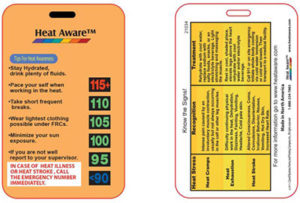 Heat exhaustion usually shows up as a worker who slows down, looks pale or flushed and soaked in sweat, complains of a headache or nausea, or needs to sit down. NIOSH also lists irritability, thirst and reduced urine output, signs of dehydration that tie directly to hydration on the job. It tends to build over a shift rather than appear out of nowhere, which is exactly why crews that know the signs catch it early. The HATS-20A version of the Heat Aware Card carries the signs, symptoms and treatment of heat illnesses on its backer, so the list is in the worker’s pocket instead of in a binder in the trailer.
What to do
The NIOSH first aid steps for heat exhaustion are:
- Get them care – Take the worker to a clinic or emergency room for evaluation, and call 911 if medical care is not available.
- Do not leave them alone – Someone stays with the worker the whole time.
- Move them out of the heat – Shade or an air-conditioned space, and remove extra clothing, including shoes and socks.
- Cool them down – Cold compresses or cold water on the head, face and neck.
- Fluids – Encourage frequent sips of cool water.
A worker treated for heat exhaustion has already told you the work and rest schedule is not keeping up with the conditions. That is information for the rest of the crew, not just the person on the bench.
Heat Stroke: The Emergency
What it looks like on a crew
Heat stroke can follow a period of heat exhaustion or come on fast during heavy work in heat, especially in heavy or impermeable clothing. The signs NIOSH lists are confusion, altered mental status, slurred speech, loss of consciousness, hot and dry skin or profuse sweating, seizures and a very high body temperature. NIOSH also warns that heat stroke can be fatal if treatment is delayed. For more on spotting it during a shift, see how to recognize heat stroke on the jobsite.
What to do while you wait for EMS
- Call 911 – Immediately. Stay with the worker until help arrives.
- Move them to shade – Or a cooler area, and remove outer clothing.
- Cool them fast – A cold water or ice bath if one is available, otherwise wet the skin, use cold wet cloths or soak their clothing.
- Move air – Circulate air around the worker to speed cooling.
- Target the big blood vessels – Place cold wet cloths or ice on the head, neck, armpits and groin.
Cooling starts before the ambulance arrives, not after. Our guide to heat stroke treatment and warning signs covers why rapid cooling is the goal and how ice water immersion and evaporative cooling compare.
Why You Should Not Try to Tell Them Apart in the Field
OSHA’s guidance on heat first aid is blunt: do not try to diagnose which illness is occurring, and when in doubt, cool the worker and call 911. OSHA also notes that diagnosis is often difficult because the symptoms of several heat illnesses can show up together, and that a worker with heat-related illness should never be left alone.
That turns the comparison above into something more useful than a diagnosis. Its job is to make sure nobody talks themselves out of calling for help because the worker is “still sweating” or “just tired.” If the person in front of you has any of the heat stroke signs, or you are not sure, the response is the same: cool and call.
Write that rule down. A written heat illness prevention program should name who makes the call, where the nearest cooling is, and how a crew gives EMS a usable location on a large site. Those details are what make the first five minutes go right.
The Other Heat Illnesses on the Same Spectrum
Heat exhaustion and heat stroke are the two that get the attention, but NIOSH lists several others that often show up first and deserve a response of their own:
- Heat cramps – Muscle cramps, pain or spasms in the abdomen, arms or legs. NIOSH advises water plus a snack or drink that replaces carbohydrates and electrolytes every 15 to 20 minutes, and avoiding salt tablets.
- Heat syncope – Fainting, dizziness or lightheadedness after standing a long time or getting up quickly. Sit or lie down somewhere cool and drink slowly.
- Heat rash – Clusters of red bumps or small blisters, usually on the neck, upper chest, groin and elbow creases. Move to a cooler, less humid area and keep the rash dry.
- Rhabdomyolysis – Muscle pain or cramping, weakness, and tea or cola colored urine, sometimes with no symptoms at all. NIOSH advises stopping activity, drinking fluids and getting immediate medical care.
A crew that recognizes cramps and fainting as heat signs is a crew that is paying attention before anyone reaches the exhaustion stage. For the bigger picture, see heat stress causes, symptoms and prevention.
Who Is Most at Risk
Anyone working in extreme heat can develop either illness, but some workers reach the warning signs sooner. Two kinds of risk stack up on a jobsite.
Risk from the job. Workers who are new to the heat or coming back after time away are not yet acclimatized. Heavy exertion, radiant heat from equipment, and heavy or impermeable PPE all add to the heat load and make it harder for sweat to cool the body.
Risk from the person. OSHA lists personal risk factors that include obesity, diabetes, high blood pressure, heart disease, a lower level of physical fitness, alcohol use, and certain medications such as diuretics. OSHA also notes that some medications can keep a worker from feeling the heat or sweating normally, so the usual warning signs may not show. A supervisor does not need anyone’s medical history to act on this: it is one more reason to treat every report of dizziness or confusion seriously.
Making Recognition a Crew Skill
 Most heat emergencies are first noticed by a coworker, not a supervisor or a medic. That makes recognition a crew skill, and crew skills come from repetition and from having the information in front of people when it matters.
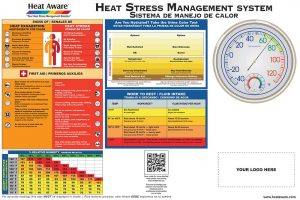
Three practical steps help. Cover heat exhaustion and heat stroke in a short heat stress toolbox talk before the hot season and again when conditions change. Put the day’s conditions where everyone stops: the HSMS-01 Heat Stress Management System Sign shows the ambient temperature and relative humidity so a crew can see where the day falls on the heat index chart. And give each worker the warning signs in a format they will actually carry, such as a Heat Aware Card.
None of these tools treats a heat illness. What they do is shorten the time between the first sign and the first response, which is where outcomes are decided.
Keep the warning signs within reach. A Heat Aware Card with the signs and symptoms backer puts the difference between heat exhaustion and heat stroke in every worker’s pocket, next to a live temperature reading.
Frequently Asked Questions
What is the main difference between heat exhaustion and heat stroke?
Heat exhaustion is the body struggling to keep up with heat, with heavy sweating, headache, nausea, dizziness and weakness while the worker still thinks clearly. Heat stroke is the body’s temperature control failing. OSHA identifies confusion, slurred speech or unconsciousness as signs of heat stroke, and heat stroke is a medical emergency.
Does a sweating worker rule out heat stroke?
Yes. NIOSH lists either hot, dry skin or profuse sweating as possible signs of heat stroke. A sweating worker who is confused or slurring their speech should be treated as a heat stroke emergency.
Does heat exhaustion lead to heat stroke if it is not treated?
Yes. Heat exhaustion that is not treated can progress to heat stroke, which is why workers showing heat exhaustion signs should stop work, be moved out of the heat, cooled and evaluated.
What should you do if you are not sure which one it is?
OSHA advises not trying to diagnose which heat illness is occurring. When in doubt, cool the worker and call 911, and never leave a worker with heat-related illness alone.
How do you cool someone with heat stroke while waiting for EMS?
NIOSH recommends moving the worker to shade, removing outer clothing and cooling quickly with a cold water or ice bath if possible, or by wetting the skin, using cold wet cloths or soaking clothing, circulating air, and placing cold wet cloths or ice on the head, neck, armpits and groin.