
A refinery stacks heat sources on top of each other. Gulf Coast heat and humidity outside, radiant heat from furnaces, steam lines and process equipment inside the units, and flame resistant clothing or chemical protective suits on top of it all. Each one alone is manageable. Together they can push a worker into heat stress on a day the weather report calls ordinary.
This page covers where heat stress in refineries and petrochemical plants comes from, who is most exposed, how it shows up on a unit, and what a heat program looks like when it is built around how a plant actually runs: rounds, turnarounds, contractor crews and layered PPE.
Where Heat Stress Comes From in a Refinery
Gulf Coast Heat and Humidity
The Gulf Coast corridor pairs high temperatures with high humidity, and humidity is what stops sweat from cooling the body. The heat index chart for workers combines air temperature and relative humidity into one number a crew can act on.
Radiant Heat From Process Equipment
Furnaces, heaters, steam tracing, hot piping and vessels add heat that a thermometer in the control room never sees. The National Weather Service notes that the heat index assumes you are in the shade, while wet bulb globe temperature (WBGT) is measured in full sun and also factors in wind speed, sun angle and cloud cover. Near a firebox or a hot exchanger, the heat index at the shelter is a starting point, not the whole picture. That is why WBGT readings taken by an industrial hygienist at the hottest work areas are worth having.
FR Clothing, Chemical Suits and Respirators
Flame resistant clothing is standard, and many jobs add chemical protective suits, hoods or respirators. Layers trap heat and block sweat from evaporating, so the body loses its main way to cool down. See preventing heat illness in workers using heavy PPE.
Heavy Work in Tight Spaces
Maintenance, vessel entry and confined space work combine heavy exertion with poor air movement. Turnaround schedules add long shifts, and the fatigue that comes with them, on top of that.
Who Is Most Exposed
Across refinery operations, outside operators on rounds and maintenance crafts carry steady exposure through the day. The highest risk often sits with people who are newest to the conditions: contractor crews brought in for turnarounds and project work, and new hires in their first weeks. Workers who are not yet acclimatized to the heat have not built up the tolerance that a crew develops over a season, and a turnaround can put hundreds of them on site at once.
That makes the contractor orientation as important as the in-house program. A heat plan that only reaches badge-holding employees misses a large share of the people doing the hottest work.
Warning Signs on the Unit
NIOSH lists heavy sweating, headache, nausea or vomiting, dizziness, weakness, irritability and thirst among the signs of heat exhaustion. Confusion, slurred speech, loss of consciousness, seizures and a very high body temperature point to heat stroke, which is a medical emergency: call 911 and start cooling the worker right away. The difference between heat exhaustion and heat stroke is worth drilling with every crew.
In a refinery, two things make those signs harder to catch. A hood or respirator hides the face, and a worker in a chemical suit may be alone at the far end of a unit. Buddy checks need to be verbal and scheduled, not left to someone noticing.
Heat Is Not Only a Summer Problem
OSHA’s own enforcement record makes the point. In 2015 the agency cited a contractor after a pipefitter cutting pipe outdoors at a Louisiana refinery died from heat-related exposure. The work took place in March. The worker was wearing four layers of clothing, including a chemical-resistant encapsulating suit, and OSHA cited the employer for failing to implement a heat management program.
The lesson for a plant is direct. Protective clothing can create dangerous heat stress outside the summer months, so a heat program that switches on in June and off in September leaves a gap. Tie heat precautions to the job, the clothing and the conditions, not just the calendar.
What a Refinery Heat Program Needs
A written heat illness prevention program for a plant covers the same core elements as any other site’s plan for heat hazards, with a few refinery specifics. Safety and health managers who already run strong process safety programs can treat heat the same way: identify the exposure, set controls, train, and check.
Readings Where the Work Happens
Monitoring belongs in the unit and near the equipment, not only at the gate or the weather station. Post the day’s heat index at each shelter, and use WBGT readings for the radiant heat areas.
Work and Rest Schedules That Account for PPE
Set work and rest cycles, including scheduled rest breaks, for the clothing the job requires. A crew in FR coveralls and a chemical suit needs more recovery time than the heat index alone suggests.
Acclimatization for Turnaround and Contractor Crews
NIOSH recommends that new workers start at no more than 20% exposure on day one, increasing by no more than 20% each day. Workers with prior experience can follow 50% on day one, 60% on day two, 80% on day three and 100% on day four. Build that ramp-up into contractor orientation and the turnaround schedule, not into a handout nobody reads.
Water, Shade and Cool-Down Areas
Put shaded or cooled shelters close to the units, with water, so a break does not mean a long walk. Fans or cooled air in enclosed shelters give crews a real place to recover. Dehydration builds over a shift, so water has to be easy to reach all day. For moderate work in the heat lasting under two hours, NIOSH’s workplace recommendations call for about 1 cup (8 oz.) of water every 15 to 20 minutes, and generally no more than 6 cups per hour.
Training, Buddy Checks and Emergency Response
Train supervisors and crews to recognize the warning signs, and have a clear plan for getting EMS to the right spot on a large site. Heat stress training materials and a short heat stress toolbox talk at the start of each shift keep the plan in front of the crew.
Heat Stress Signs and Heat Aware Cards for Refinery Crews
Awareness is the control that ties the program together: a crew that can see the heat index and knows the warning signs acts sooner. Here is how Heat Aware’s tools map to a plant.
Heat Stress Management System Signs for Unit Shelters and Cool-Down Areas
Best for fixed shelters where crews already stop.
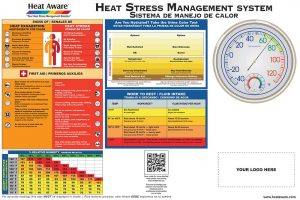 A heat stress management system sign at a unit shelter or cool-down area shows the ambient temperature and relative humidity so operators and crafts can see where the day falls on the heat index. Heat Aware notes the signs must be displayed in the shade for an accurate thermometer reading. Your company logo is printed on the sign. See the full range of heat stress signs and posters.
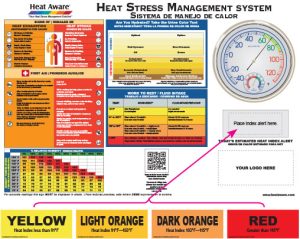 The HSMS-02 sign with magnet heat index adds four colored, labeled magnets so a supervisor can mark the day’s heat stress range for every crew that walks past.
Heat Aware Cards for Every Badge Holder
Best for operators and crafts who move between the control room and the unit.
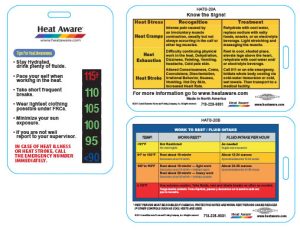 Heat Aware Cards are TWIC-sized, so they sit in the same holder as the cards refinery workers already carry. They register the ambient temperature around the person carrying them, which follows the worker from the control room into the unit. The backers carry either the signs and symptoms of heat illness or a work and rest fluid intake guide.
Custom Cards for Contractor Orientation
Best for plants that onboard turnaround and project crews.
The HATSC-30 custom TWIC-sized card can be printed with your company’s logo and HSE information and built with input from your IH and EHS managers, so every contractor leaves orientation carrying your heat rules. The liquid crystal can also be set up to read in Celsius.
Hard Hat Stickers and Cooling Gear
Best for keeping the reminder in view during the shift.
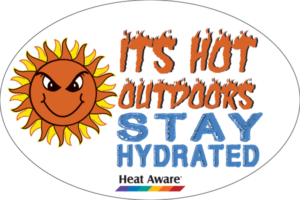 Hard hat stickers printed with UV inks on weatherproof vinyl put a hydration reminder where coworkers see it all day. The shop also carries cooling gaiters and cooling skull caps.
See how the pieces fit together in what a heat stress management system includes, or browse other industries Heat Aware serves.
Equip your units and your turnaround crews. Heat stress management system signs for cool-down areas and branded Heat Aware Cards for contractor orientation, built around how your plant runs. Call Heat Aware at 713-228-9331 to talk through signs and custom cards for your site.
Frequently Asked Questions
Why is heat stress a bigger risk in refineries?
Refineries combine several heat sources at once: outdoor heat and humidity, radiant heat from furnaces and process equipment, and flame resistant clothing or chemical protective suits that trap heat and block sweat from evaporating.
Is the heat index enough to judge heat stress in a refinery?
It is a good daily starting point, but the National Weather Service notes the heat index assumes shade. Wet bulb globe temperature (WBGT) is measured in full sun and also factors in wind, sun angle and cloud cover, so WBGT readings give a fuller picture for work in the sun or near radiant heat sources.
Can refinery workers get heat stress outside of summer?
Yes. Protective clothing and process heat can create dangerous heat stress in cooler months. In 2015 OSHA cited a contractor after a pipefitter wearing four layers of clothing, including a chemical-resistant suit, died from heat exposure while working at a refinery in March.
Who is most at risk during a refinery turnaround?
Contractor crews and new workers who are not yet acclimatized to the heat, especially when the work involves heavy exertion and layered protective clothing.
How should contractor crews be acclimatized before a turnaround?
NIOSH recommends that new workers start at no more than 20% exposure on day one and increase by no more than 20% each day. Workers with prior experience can follow 50%, 60%, 80% and 100% over four days.
Where should heat stress signs go in a refinery?
At shaded or cooled shelters and cool-down areas close to the units, where crews already stop. Heat Aware notes its heat stress management system signs must be displayed in the shade for an accurate thermometer reading.
Do Heat Aware Cards measure body temperature?
No. According to Heat Aware, the card registers ambient temperature, the temperature of the area around the person carrying it, not body temperature.