
Heat is the number one weather related killer in the United States, and air temperature alone understates it. A 92°F afternoon at 40 percent humidity and a 92°F afternoon at 75 percent humidity are different days for a crew, and only one of those numbers shows up on the forecast. The heat index closes that gap.
This page gives you a heat index chart built for jobsite use, explains what each risk level means for the health of people doing physical work, and shows how to put the number where the crew can see it.
In this article
What the heat index is
The heat index is how hot it feels when relative humidity is combined with the air temperature. Sweating is how the human body sheds heat, and it only works when the sweat can evaporate off the skin. When the air is already holding a lot of moisture, sweat evaporates slowly, the body sheds less heat, and the same air temperature puts more strain on a worker.
The National Weather Service publishes the heat index in degrees Fahrenheit so it can be compared directly with the thermometer. Two things about it matter on a jobsite. The published values assume shade and light wind conditions, and NWS notes that full sunshine can raise them by up to 15°F. And the heat index describes the weather, not the work. Heavy exertion, heavy clothing and a worker who is not yet acclimatized all add risk that the number does not show.
Heat index chart
Find the air temperature across the top and the relative humidity down the side. Follow both lines to where they cross, and that number is the heat index. For example, 94°F at 60 percent humidity reads 110°F, which is already in the Danger band. The chart covers air temperatures from 80°F to 110°F, the range most crews work through in a Gulf Coast summer. Colors follow the National Weather Service risk levels. Cells above 137°F are left blank, as they are on the NWS chart.
| RH \ Temp | 80°F | 82°F | 84°F | 86°F | 88°F | 90°F | 92°F | 94°F | 96°F | 98°F | 100°F | 102°F | 104°F | 106°F | 108°F | 110°F |
|---|---|---|---|---|---|---|---|---|---|---|---|---|---|---|---|---|
| 40% | 80 | 81 | 83 | 85 | 88 | 91 | 94 | 97 | 101 | 105 | 109 | 114 | 119 | 124 | 130 | 136 |
| 45% | 80 | 82 | 84 | 87 | 89 | 92 | 96 | 100 | 104 | 109 | 114 | 119 | 124 | 130 | 137 | |
| 50% | 81 | 83 | 85 | 88 | 91 | 95 | 99 | 103 | 108 | 113 | 118 | 124 | 131 | 137 | ||
| 55% | 81 | 84 | 86 | 89 | 93 | 97 | 101 | 106 | 112 | 117 | 124 | 130 | 137 | |||
| 60% | 82 | 84 | 88 | 91 | 95 | 100 | 105 | 110 | 116 | 123 | 129 | 137 | ||||
| 65% | 82 | 85 | 89 | 93 | 98 | 103 | 108 | 114 | 121 | 128 | 136 | |||||
| 70% | 83 | 86 | 90 | 95 | 100 | 106 | 112 | 119 | 126 | 134 | ||||||
| 75% | 84 | 88 | 92 | 97 | 103 | 109 | 116 | 124 | 132 | |||||||
| 80% | 84 | 89 | 94 | 100 | 106 | 113 | 121 | 129 | ||||||||
| 85% | 85 | 90 | 96 | 102 | 110 | 117 | 126 | 135 | ||||||||
| 90% | 86 | 92 | 98 | 105 | 113 | 122 | 131 | |||||||||
| 95% | 88 | 94 | 101 | 109 | 117 | 127 | 137 | |||||||||
| 100% | 89 | 96 | 104 | 112 | 121 | 132 |
Caution 80 to 89°FExtreme Caution 90 to 102°FDanger 103 to 124°FExtreme Danger 125°F and above
Values calculated with the National Weather Service heat index equation and rounded to the nearest degree. NWS states the equation is accurate to within about 1.3°F, so a value here can differ by a degree from a published NWS chart. The National Weather Service heat index page is the reference source.
The four risk levels
The National Weather Service groups heat index values into four levels. The effects below summarize the NWS descriptions for prolonged exposure or physical activity, which is the normal condition for a working crew.
Caution: 80°F to 89°F
Fatigue is possible with prolonged exposure or physical activity. This is the range where a written program usually makes sure water, shade and rest are in place, because sweat losses and dehydration build over a long shift even at this level and the crew knows what the day looks like.
Extreme Caution: 90°F to 102°F
NWS flags this band because all three heat illnesses, cramps, exhaustion and stroke, become possible once the exposure runs long or the work is physical. Most programs tighten the work and rest schedule here and put a named person on watch for early signs.
Danger: 103°F to 124°F
NWS expects heat cramps and heat exhaustion in this band for anyone with long exposure or physical activity, and heat stroke becomes a real possibility. Heavy tasks get rescheduled, rest breaks get longer, and new or returning workers who have not finished acclimatization are kept off the hardest work.
Extreme Danger: 125°F and above
Heat stroke is highly likely. At this level the question is whether the work should be happening in the heat at all.
How the heat index is calculated
The heat index is not a measurement. It is calculated from two measurements, air temperature and relative humidity, using an equation the National Weather Service derived from research on how the body exchanges heat with the air. The equation is a regression with nine terms, and NWS applies small corrections when humidity is very low or very high.
You do not need to work the equation by hand. A heat index calculator, such as the NWS heat index calculator, does the math, and the chart above covers the range most crews see. What matters is what it shows: humidity drives the number up fast once the air is hot. At 100°F and 55 percent humidity, the heat index is 124°F, the top of the Danger band. At 88°F and 70 percent humidity, a day that does not feel extreme on the thermometer, it is already 100°F.
That is the practical reason to read humidity on site rather than relying on the morning forecast. The forecast, and any heat advisory or warning that comes with it, is for a weather station. The crew is working next to a hot process, on a roof deck, or inside an enclosure where humidity is higher than outside.
Reading the chart on a jobsite
A heat index chart is only useful if the number it gives you changes what happens next. Treat the chart as the input and your written program as the decision.
- Read it in the shade, then adjust for the sun – The chart assumes shade and light winds. A crew in direct sunlight is effectively working at a higher heat index, by as much as 15°F according to NWS.
- Add the work to the weather – Heavy exertion, heavy or impermeable PPE, and radiant heat from equipment all add strain the heat index does not include.
- Read it more than once – The heat index at 7 a.m. and the heat index at 2 p.m. are different numbers. Decide before summer when readings are taken and who takes them.
- Tie each level to an action – A threshold with no response is a number on a wall. The heat illness prevention program page covers how to write the responses down.
Where OSHA fits
OSHA has no final heat standard. The rule it proposed in August 2024 would use a heat index of 80°F as an initial heat trigger and 90°F as a high heat trigger. OSHA renewed its heat inspection program in April 2026 and treats a heat index of 80°F or higher as a priority. Until a standard is final, the General Duty Clause is what applies, and no chart or product satisfies an employer’s obligation on its own.
Putting the heat index where the crew can see it
A heat index chart in a binder does not reach the crew. Heat safety on a jobsite depends on the people doing the work seeing the same number the supervisor sees. The awareness tools below put the inputs and the risk level where the work happens.
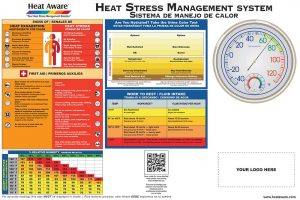
 HSMS-01 Heat Stress Management System Sign – The sign carries a thermometer that shows the ambient temperature and the relative humidity, so a crew can read both values and see the heat index danger zone for the day. It reads correctly when it is displayed in the shade, which matches how the chart is built.
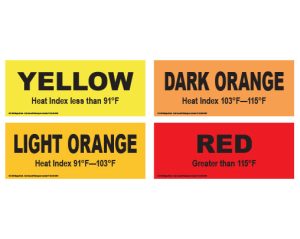
 HSMS-02 sign with magnet heat index – The HSMS-02 has the same features plus four colored, labeled magnets, so the supervisor can mark the heat stress range for the day where everyone stops to drink. The magnets mark four heat index bands: under 91°F, 91°F to 103°F, 103°F to 115°F, and over 115°F. Those bands sit close to the NWS levels in the chart above but do not match them exactly, so pick one scale for your written program and use it everywhere.
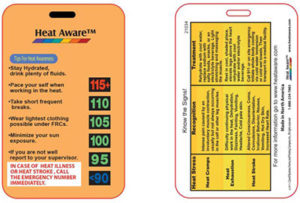
 Heat Aware Cards – The card registers the ambient temperature around the person carrying it, so the temperature side of the chart travels with the worker into the hot area. The HATS-20 comes with a signs and symptoms backer or a work and rest fluid intake backer.
None of these tools prevents heat illness on its own, and none of them replaces a written plan. What they do is make the conditions visible, which is what the rest of the plan depends on. For the full set, see what a heat stress management system includes or browse the shop. For pricing, availability, volume and custom or branded orders, email bryan@heataware.com.
Frequently asked questions
What heat index is dangerous for outdoor work?
The National Weather Service puts a heat index of 103°F to 124°F in its Danger category and 125°F or higher in Extreme Danger. Risk starts lower than that for crews doing heavy work, wearing heavy PPE or working in direct sun, which is why many written programs set their first trigger at 80°F or 90°F rather than waiting for the Danger band.
Is the heat index the same as the temperature?
No. The heat index puts air temperature and relative humidity into one number that reflects the strain a worker actually feels. At 90°F, the heat index is 91°F at 40 percent humidity and 109°F at 75 percent humidity. Humidity is the part people tend to guess wrong.
Does the heat index chart account for direct sun?
No. The National Weather Service chart assumes shade and a light wind. NWS notes that full sunshine can raise heat index values by up to 15°F, so a crew working in the open should read the chart higher than the number shows.
Does the Heat Aware Card show the heat index?
No. The Heat Aware Card registers the ambient temperature of the area around the wearer, not the heat index and not body temperature. The HSMS-01 sign carries a thermometer and a humidity reading, so a crew can read both values and find the heat index zone for the day.
What heat index does OSHA use?
OSHA has no final heat standard. The rule it proposed in 2024 would use a heat index of 80°F as an initial heat trigger and 90°F as a high heat trigger, and its heat inspection program, renewed in April 2026, treats a heat index of 80°F or higher as a priority. Until a standard is final, the General Duty Clause is what applies.