
Heat is the number one weather related killer in the United States, and the work that exposes people to it rarely stops because the forecast is bad. What decides whether a hot week passes without incident is not the weather. It is whether the employer decided in advance what happens on a day like that, wrote it down, and told the crew.
That written decision is a heat illness prevention program. It is the document that says who watches the conditions, when the crew takes water and rest, what happens to a new worker in the first week, and who calls for help when somebody goes down. This page sets out what goes in one, how the awareness tools on a jobsite connect to it, and where to start if nothing is written down yet.
In this article
- What a heat illness prevention program is
- Where OSHA fits, and what the General Duty Clause means for an employer
- The six elements a written program needs
- Acclimatization: the element most programs leave out
- Making the program visible on the jobsite
- Starting from nothing, in one week
- Frequently asked questions
What a heat illness prevention program is
A heat illness prevention program is a written plan that says what an employer does about heat before the hot day arrives, rather than during it. It is sometimes called a heat illness prevention plan, and the two names describe the same document.
The distinction that matters is between a program and a habit. Most crews already have habits. Somebody brings a cooler, somebody tells the new guy to take it easy, and the supervisor calls an extra break when the afternoon gets rough. Those habits work until the supervisor who holds them is on vacation, or until the crew doubles for a turnaround and half the people on site have never worked in that heat before.
A written program takes the judgment out of the moment. It sets the trigger, names the response, and assigns the person. When the heat index crosses a stated number, a stated thing happens, and a stated person is responsible for making it happen. That is the whole value of writing it down.
It is also what an inspector, an insurer or a client asks for when they want to know how an employer protects the health of the people doing hot work. A heat stress management system is the set of tools that make the program visible on the jobsite. The program is the reasoning behind them.
Where OSHA fits, and what the General Duty Clause means for an employer
OSHA has no final heat-specific standard. That is often read as meaning heat is unregulated, and it is the wrong reading.
In August 2024 OSHA proposed a heat standard, which would require a written heat plan, heat index trigger levels, water, rest and shade, acclimatization for new workers, and training. The public comment and hearing process closed in October 2025, and no final rule or date has been set. In April 2026 OSHA renewed its heat inspection program for five years, so heat stays an enforcement priority. Until a standard is final, the General Duty Clause is what applies.
The General Duty Clause requires an employer to keep the workplace free from recognized hazards that are causing or likely to cause death or serious physical harm. Heat is a recognized hazard. An employer who knows that a hot process, a hot season or a hot enclosure puts workers at risk, and who has decided nothing about it, is exposed under that clause whether or not a heat standard exists. Our longer explainer on what OSHA requires for heat safety covers the clause in detail.
What that means in practice is simple. The employer carries the obligation, not the product, not the sign and not the card. No item that anybody sells, including everything Heat Aware makes, satisfies a legal requirement on its own or certifies a workplace as compliant. What a written program does is document that the employer recognized the hazard and decided in advance what to do about it. Awareness is the control. Everything else supports it.
Federal rulemaking on heat has been in motion for several years. If a current rule status matters to a decision you are making, check osha.gov directly rather than relying on anything written down a season ago, including this page.
The six elements a written program needs
A program that fits on two pages and gets followed beats a forty page document nobody has read. These are the six things a plan has to answer.
1. Who is covered, and where
Name the crews, the employees and the work areas, and the seasons each one applies to. An indoor bakery floor and an outdoor deck are different exposures and a plan that covers only one of them leaves people out. Include contractors and temporary workers by name, because they are the group most often missed on a shared worksite.
2. How conditions get measured
Say what gets read, where it gets read, and how often. Use the heat index rather than air temperature alone, because sweat that cannot evaporate does not cool anybody, and humidity is the variable people guess wrong. Two afternoons with the same temperatures can carry very different risk. Say who does the monitoring and what they do with the reading.
3. Drinking water, rest breaks and shade
State the amounts and the intervals rather than saying that water is available. Availability is not a plan. Write down how much drinking water each person should be getting through an hour of hot work, when rest breaks happen at each heat index level, where the cool down area is, who is allowed to send somebody to it, and that nobody needs permission to use it. Hydration that depends on someone remembering to ask does not happen on a busy day.
4. Acclimatization
Write the schedule for new workers and for anybody returning after a week away. This is the element most often missing and it is covered separately below.
5. Recognition and response
List what heat exhaustion and heat stroke look like on the jobsite, name which supervisors and crew members are trained to act, and write the emergency steps, including the first aid to start, who calls 911 and who meets the ambulance. A plan that stops at recognition is half a plan.
6. Training and records
Say which employees and supervisors get trained, on what, and how often it is refreshed. A short heat stress toolbox talk at the start of a hot stretch is usually the most practical format, and it creates the record at the same time.
Write each element in the words your crew uses. A plan written in regulatory language gets filed; a plan written in shift language gets used.
Acclimatization: the element most programs leave out
A body adjusts to working in heat, and it takes days rather than hours. Until it has adjusted, the same task in the same conditions carries a higher risk for that person than it does for the crew around him.
This is why the pattern of serious heat incidents clusters around new starters, returning workers and the first genuinely hot stretch of the season. A crew that has been working through August is not the same crew, physiologically, as the one that walked onto the job in May, and neither is the person who spent last week on vacation.
An acclimatization schedule is a short paragraph. It says that a new or returning worker builds up to a full workload across the first several days, that somebody is watching him while he does, and that the buildup restarts after an absence. Writing it down is what turns it from a thing everybody agrees with into a thing that happens when the schedule is tight.
The start of the season is when this element earns its place. So is the first week of a turnaround, when headcount doubles and most of the additions have not worked in that plant before.
Making the program visible on the jobsite
A written program that lives in a binder in the site office is a document. A program the crew can see is a control.
The gap between the two is the thing awareness tools close. Each one puts a piece of the written plan where the work happens.
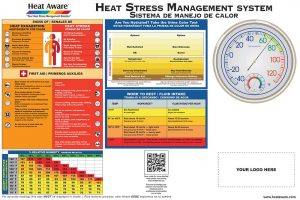
 Heat stress signs and posters – Post the day’s temperature and humidity where crews stop to drink, so the condition the plan refers to is a number everyone can read rather than a judgment a supervisor asserts. The HSMS-01 sign and the HSMS-02 with magnets both do this.
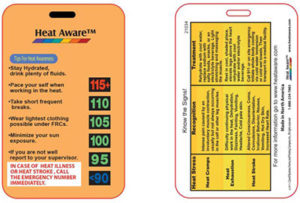
- Heat Aware Cards – Put the signs and symptoms and the work and rest guidance in a pocket, so the recognition element of the plan travels with the person rather than staying on the wall. The HATS-20 and HATS40 are the standard versions.
- Hard hat stickers and decals – Keep the message in view for a whole shift on the one piece of equipment nobody takes off.
None of these items prevents heat illness and none of them is a program. Water, rest, shade, acclimatization and a supervisor paying attention are what prevent heat illness. What the tools do is make sure the crew knows what kind of day it is, which is the condition everything else depends on.
Starting from nothing, in one week
Most employers who do not have a written program are not opposed to having one. They have not had a week where writing it was the most urgent thing.
It does not take a week. It takes an afternoon, in this order.
- Write down what already happens – Start from the habits the crew already has. Most sites are closer to a plan than they think, and the first draft is usually a transcription rather than an invention.
- Add the trigger numbers – Decide what heat index changes the schedule, and what it changes it to. This is the step that turns a description into a plan.
- Fill the two gaps – Acclimatization and the emergency response are the two elements most first drafts are missing. Write both.
- Name people, not roles – A plan that assigns a task to a job title gets nobody. A plan that names who reads the sign each morning gets read.
 Put it in front of the crew – Run it as a toolbox talk, hang the sign, hand out the cards. A plan nobody has heard is not in effect.
If you want the awareness side handled as one package rather than assembled piece by piece, Heat Aware builds complete heat stress management system packages, and custom and branded options are available. Email bryan@heataware.com for availability, volume and custom orders, or browse the shop.
Frequently asked questions
Is a heat illness prevention program required by law?
OSHA has no final heat-specific standard, so no federal rule names this document yet. A rule proposed in 2024 would require a written heat plan, but it has not been finalized. The General Duty Clause still requires an employer to address recognized hazards, and heat is one. A written program is how an employer documents that the hazard was recognized and decided about in advance. State and local requirements differ, so check what applies where you work.
What is the difference between a heat illness prevention plan and a heat stress management system?
The plan is the written document: who is covered, what the triggers are, and who does what. The management system is what makes the plan visible where the work happens, which is the signs, the cards and the decals the crew reads during the shift. One is the reasoning, the other is how the crew sees it.
How long does a heat illness prevention program need to be?
Short enough that a supervisor reads it. Two pages that name real people and real numbers work better than a long document written in regulatory language, because the test of a program is whether the crew behaves differently on a hot day, not how thorough it looks in a binder.
Who should write it?
Somebody who has worked the job it covers, with a safety lead reviewing it. A plan written entirely from outside usually misses the conditions that actually make a site hot, such as an enclosure, a process, or the one area with no airflow.
When should the program be reviewed?
Before the hot season starts, and after any heat incident or near miss. A seasonal walkthrough is also the natural time to check that the signs still work, that the thermometers read correctly, and that the crew that will be on site this year has been trained.
Does acclimatization apply to experienced workers?
Yes. Acclimatization is lost after time away, so an experienced worker returning from a week off is in the same position as a new starter for the first days back. Writing that into the plan is what stops it being forgotten during a busy restart.