Heat illness does not announce itself. A worker who is sliding toward heat exhaustion usually looks like a worker having a hard morning, and the people best placed to notice are the ones standing next to him. That is what a toolbox talk is for. Ten minutes before the shift, in the language the crew actually uses, aimed at the one thing you want them to do differently today.
This is a heat stress toolbox talk you can deliver without preparation, plus the questions that come back at you and how to answer them. Awareness is the control that prevents heat illness, and a talk is how awareness gets installed in a crew rather than filed in a binder.
In this article
- What to settle before you open your mouth
- The ten minute talk, in order
- Teaching the buddy check so it survives contact with the job
- Props beat handouts
- Three talks that did not work
- How often to run it, and how to keep it from going stale
- What to write down afterward
- Frequently asked questions
What to settle before you open your mouth
Read the day first. A toolbox talk that ignores the conditions in front of the crew gets tuned out in the first sentence, and rightly so. Before the talk, know three numbers and one fact.
The three numbers are the forecast high, the humidity, and the heat index the two of them produce together. Humidity is the number crews underestimate. Ninety five degrees in dry air and ninety five degrees at seventy percent relative humidity are not the same shift, because sweat that cannot evaporate does not cool anybody. The one fact is who on the crew is new, back from vacation, back from sick leave, or working in heavier gear than usual. Those are the people most likely to go down, and they are the reason to give the talk at all rather than skip it because the crew has heard it before.
Then pick one behavior. Not five. A talk that asks for five changes gets none of them. Today it might be drinking before the break rather than at it, or it might be that nobody works a hot task alone. Choose it before you start so the talk has somewhere to land.
The ten minute talk, in order
 Minute one, the conditions. Say the heat index out loud and say what it means for today’s work. “It is going to feel like a hundred and four by two o’clock, and we are on the south side of the building all afternoon.” Concrete beats general.
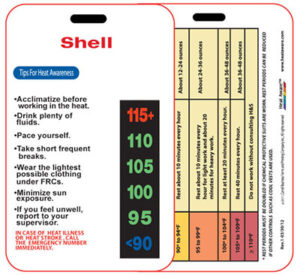
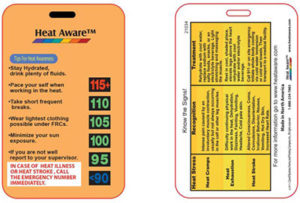
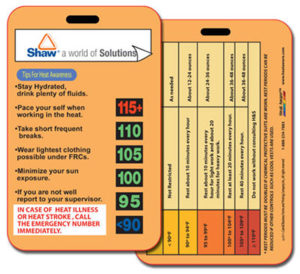
Minutes two to four, the signs. Go through what heat illness looks like from the outside, because that is the version a crew can act on. Heavy sweating that stops. Skin that goes clammy, or goes dry and hot. Cramping. A headache. Nausea. Somebody getting quiet, getting clumsy, repeating himself, or getting short tempered for no reason. Confusion and a stumble are late signs, not early ones, and a worker who has reached them needs help immediately rather than a break. The HATS-20 Heat Aware Card carries this list on the back, which is why handing one out beats reading it from a page.
Minutes five to seven, the controls. Water, rest, shade, in that order, and be specific about all three. Where the water is. When the breaks are. Where the shade actually is on this site today, not where it was last week. If you have a heat stress management system sign in the cool down area, point at it and tell them what the thermometer and the humidity reading on it are for.
Minutes eight and nine, the one behavior. Ask for it plainly, explain why it is today’s ask, and say what it looks like done right. Then ask somebody to repeat it back. A talk where nobody speaks is a talk nobody remembers.
Minute ten, the escalation. Who to tell, how, and what happens next. If a worker is confused, stumbling, or cannot be cooled down, that is an emergency call, not a supervisor conversation. Say the words “call nine one one” rather than leaving it implied.
Teaching the buddy check so it survives contact with the job
 Most heat programs contain a buddy system. Most buddy systems quietly stop happening by the second week of August, because “keep an eye on each other” is not an instruction anybody can follow while running a saw.
Make it mechanical instead. Name the pairs out loud at the talk. Give the check a trigger, so it happens at a moment rather than continuously: at every water break, ask your partner one question and look at him while he answers. Give them the question. “How are you doing” gets “fine” from everybody. “What did you have to drink on the last break” gets an answer you can judge, and so does asking a man to repeat the task sequence back.
New and returning workers get a different pairing
Acclimatization is the control most often missing from a program. A worker who has not been in the heat for a week has lost some of the adaptation he built, and the first days back are the dangerous ones. Pair new and returning people with someone experienced, keep their first days shorter and lighter, and say at the talk that this is deliberate rather than a favor. Working in dangerous heat you are not accustomed to is its own hazard and worth treating as one.
Props beat handouts
A handout gets folded into a pocket and washed. Something a worker carries or wears stays in the work.
Cards. A Heat Aware Card is TWIC-sized, so it goes in a wallet or behind a badge and comes back out at the next talk. The HATS40 card carries a work and rest reference on the back, which turns “take more breaks” into a specific answer.
Hard hat decals. Hard hat stickers for heat stress awareness put the message where a crew sees it a hundred times a shift without anybody having to say it again. The HADH decal reads Stay Hydrated and the HADS decal reads Drink Early, Drink Often. Heat Aware prints them with UV inks on weatherproof vinyl.
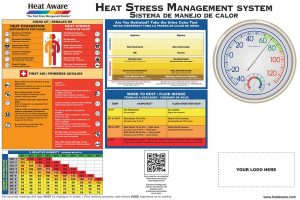 The sign in the cool down area. A sign with a thermometer and a hygrometer on it makes the day’s conditions a shared fact instead of an argument. It has to hang in the shade to read accurately, which is worth saying at the talk, because a sign in the sun reads high and teaches the crew to distrust it.
Three talks that did not work, and what was wrong with them
Most heat talks fail in one of a few predictable ways, and each has a specific fix.
The talk that was a policy reading. A supervisor reads the heat section of the safety manual out loud, start to finish, in the same words every week. It covers everything, which is the problem: nothing in it is about today, so there is nothing for a worker to act on. The fix is to cut it to one behavior and attach it to the conditions in front of the crew.
The talk nobody could act on. A crew is told to take breaks as needed and to stay hydrated. Both are true and neither is an instruction. As needed means whatever the busiest man on the crew decides, which in practice means later than it should be. The fix is to name the thing: where the water is, when the breaks are, what counts as a drink, and who decides when the schedule changes.
The talk that was delivered to the wrong people. Everything goes to the crew and nothing goes to the supervisors. But recognizing heat illness in somebody else, and having the authority to stop work, are supervisor jobs. A crew that has been told to speak up and a supervisor who has not been told to listen produces the worst outcome of all, which is a worker who said something and was waved off. Run a version of the talk for the people who make the call, and tell the crew you have done it.
How often to run it, and how to keep it from going stale
Weekly through the hot season is a reasonable floor, daily when the heat index climbs into the range where your program calls for extra breaks, and again whenever the crew changes or the work moves to a hotter part of the site. The talk that matters most is the one on the first genuinely hot day of the year, before anybody has acclimatized.
Staleness is the real risk, and rotating one thing prevents it. One week the talk is the signs. The next it is hydration and what actually counts as a drink. The next it is a walk of the site to find where the shade and water will be. Ask a different person each week to say one thing he saw last week. A talk that only ever comes out of the supervisor’s mouth stops being heard in about a month.
What to write down afterward
Keep the record short enough that it actually gets kept. The date, the conditions, who attended, the one behavior you asked for, and anything a worker raised. Two lines and a signature sheet is plenty.
The reason to keep it is not paperwork. It is that a pattern only becomes visible in writing. Three weeks of notes saying the water station is too far from the work face is a site layout problem, and nobody would have spotted it from three separate conversations. Under the General Duty Clause an employer is responsible for recognized hazards in the workplace, and heat is one; OSHA has no heat-specific standard of its own. A record of what you told the crew, and what you changed when they told you something back, is the honest evidence that the hazard was being managed.
Frequently asked questions
How long should a heat stress toolbox talk be?
Ten minutes is enough, and shorter is better than longer. A talk that runs past about fifteen minutes stops being absorbed. Cover the day’s conditions, what heat illness looks like from the outside, where water, rest and shade are, one behavior you want changed today, and who to call in an emergency.
What should the crew be able to do after the talk?
Three things. Name two or three outside signs of heat illness in a coworker, say where water and shade are on this site today, and say who they call and how if somebody is confused or cannot be cooled down. If they can do those three, the talk worked.
How often should we hold one during the summer?
Weekly through the hot season as a floor, daily when the heat index reaches the range where your program calls for extra breaks, and again whenever the crew changes or the work moves to a hotter area. The first genuinely hot day of the year is the most important one, because nobody is acclimatized yet.
Do we need a written heat program to run toolbox talks?
No. You can start talking to the crew this week. A written program is what makes the talks consistent between supervisors and between sites, and it is what tells everybody the same thing about break schedules, water, acclimatization and escalation, so the two work together rather than one replacing the other.
Related pages
- Hard hat stickers for heat stress awareness. The three Heat Aware decals, what each one says, and how they are printed.
- Heat Aware Cards. What the cards carry on each side and why crews keep them.
- HSMS-01 heat stress management system sign. The sign for cool down areas, with a thermometer and humidity reading.
- A guide to protecting work crews from the summer heat. The wider set of controls a talk sits inside.
- Why a heat safety plan belongs in operations. How the talk, the plan and the site controls connect.
- Shop heat stress products. Cards, signs, decals and cooling products in one place.
For pricing, availability, volume and custom or branded orders, email bryan@heataware.com or call Heat Aware at 713-228-9331.